How MOQ works in olive wood wholesale, and why the price does not move with volume
BY THE ARTISRAW EDITORIAL TEAM · AUGUST 11, 2026 · UPDATED OCTOBER 6, 2026 · 9 MIN READ
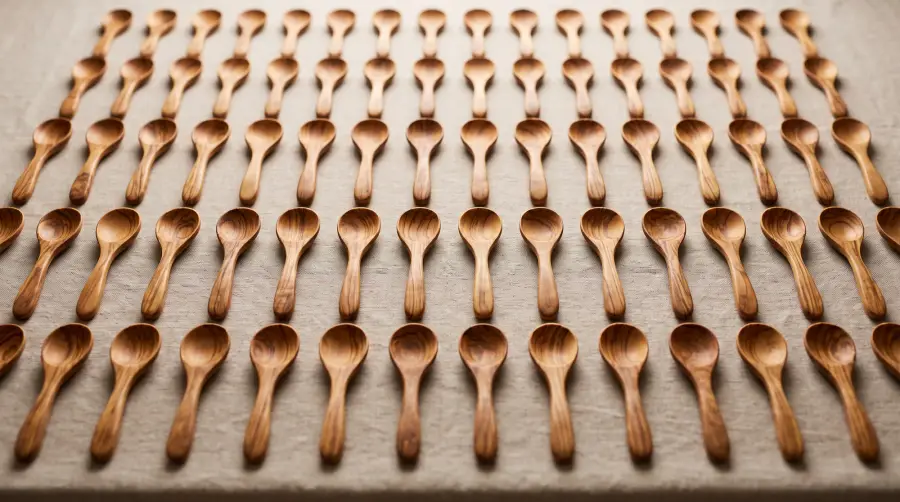
One SKU, one batch: the pieces in a run share blanks, a bench and a finishing lot. That is what a minimum pays for.
Minimum order quantities here run from 5 to 100 pieces depending on the category, they apply per SKU rather than per order, and the wholesale price per piece does not change with volume. So the question “what do I have to order to get the good price?” has an unusual answer: the good price is the only price. What the minimum decides is whether a production run is worth setting up — which is why twelve references at their minimums is a harder order to make than four references taken deeper.
This guide gives the minimums by category, shows the arithmetic on two real orders of the same size, and sets out what actually moves your landed cost, since the unit price will not.
Why a handmade line prices flat
A moulded product gets cheaper per unit as the run lengthens, because the expensive part is the tooling and it is already paid for. A carved product does not work that way. Every piece is shaped, sanded and finished by an artisan, and the tenth is the same amount of work as the ten-thousandth. There is no tooling to amortise, so there is no volume curve to pass on. Quoting one anyway would mean either overcharging the small order or underpricing the large one.
The minimum is what makes a run worth setting up: preparing blanks, dedicating a bench, running the batch through finishing and quality control as one lot. Below it the setup dominates; at or above it, the economics work at the standard price.
The minimum is per SKU, not per order
This is the part that most often surprises a first-time buyer. A minimum of 50 on a cooking spoon means fifty of that spoon in that size — not fifty pieces spread across the range. Each size carries its own SKU and its own minimum, because each size is its own production run.
Three sizes of one model are therefore three minimums. They do schedule better than three unrelated products, because they share preparation and the same bench setup, but each size still has to reach its own number.
The minimums, by category
These are the ranges across each family’s SKUs, taken from catalogue v64. The figure that applies to your order is the one printed on the individual SKU, on its product page, in pieces.
| CATEGORY | MINIMUM PER SKU | SKUS | WHY IT SITS THERE |
|---|---|---|---|
| Cutting Boards | from 5 | 133 | Cut and finished individually; the cheapest family to test with |
| Chess & Board Games | from 5 | 109 | Assembled sets, made to order |
| Baskets & Bowls | 5–30 | 58 | Turned one at a time; larger diameters start lower |
| Vintage Decoration | 5–100 | 49 | The widest spread: one-off pieces at one end, small repeats at the other |
| Mortars & Pestles | 10–30 | 26 | Two turned parts per unit, matched by hand |
| Trays & Plates | 10–30 | 79 | Flat work, batched by size |
| Jars & Containers | 20–50 | 42 | Body and lid have to be fitted to each other |
| Drinkware & Tumblers | 20–100 | 39 | Hollowed and finished inside and out |
| Utensils & Gadgets | 20–100 | 69 | Small items, made in batches |
| Bath & Beauty | 20–100 | 46 | Small turned and carved pieces |
| Spoons & Spatulas | 50–100 | 121 | The highest minimums: carved in batches, and the fastest-moving family |
One category is deliberately not in that table. The minimum for personalised gifts is under review internally — our own records and our Private Label page do not currently agree on it — so rather than print a number we would have to correct, we would rather you asked. Talk to us about a private-label or engraved programme → and we will confirm the current figure in writing with your quotation.
Worked example: the same 320 pieces, two ways
Both orders below are 320 pieces. Both are priced identically per SKU, because the price does not move with volume. The difference is twelve production runs against four — and what arrives on your shelf.
Order A — one carton of everything
| SKU | WHAT IT IS | MINIMUM | ORDERED |
|---|---|---|---|
| CB001-20 | Cutting board, round handle, 20 cm | 5 | 5 |
| CB001-25 | Cutting board, round handle, 25 cm | 5 | 5 |
| CB001-30 | Cutting board, round handle, 30 cm | 5 | 5 |
| CB002-25 | Cutting board, rectangular handle, 25 cm | 5 | 5 |
| BS004-20 | Rustic salad bowl, 20 cm | 10 | 10 |
| BS004-22 | Rustic salad bowl, 22 cm | 10 | 10 |
| TP029-D1 | Rectangular tray with handles | 20 | 20 |
| MP001-10 | Round mortar and pestle, 10 cm | 30 | 30 |
| MP002-12 | Rustic mortar and pestle, 12 cm | 30 | 30 |
| DT001 | Large drinking cup | 30 | 30 |
| DT003 | Medium drinking cup | 50 | 50 |
| SS001-30 | Cooking spoon, 30 cm | 50 | 120 |
| 12 SKUs | 12 production runs | — | 320 |
What this order puts on a shelf: five of each board size, ten of two bowl sizes, twenty trays. A customer who likes the 25 cm board buys it, and the facing is empty until the reorder lands. Nine of the twelve lines are at their floor, so nothing can be reordered in a hurry without starting the same twelve setups again.
Order B — four references, taken deeper
| SKU | WHAT IT IS | MINIMUM | ORDERED |
|---|---|---|---|
| CB001-25 | Cutting board, round handle, 25 cm | 5 | 100 |
| SS001-30 | Cooking spoon, 30 cm | 50 | 100 |
| BS004-22 | Rustic salad bowl, 22 cm | 10 | 60 |
| MP001-10 | Round mortar and pestle, 10 cm | 30 | 60 |
| 4 SKUs | 4 production runs | — | 320 |
Same 320 pieces, same price per piece, a third of the setups. And a shelf that can actually trade: a hundred of one board is a facing that survives a good weekend, and the sell-through tells you something. Order A tells you only that one of everything sold.
The reorder is where this compounds. Order B’s four lines can be repeated as four runs. Order A’s twelve lines, nine of them at their floor, cannot be topped up selectively without re-running the whole spread.
The middle path: one model, three sizes
If you want range rather than depth, take it within a model instead of across the catalogue. CB001 at 20, 25 and 30 cm is three SKUs at 5 each, so fifteen pieces opens three price points of the same board — and because the three share blanks, preparation and bench setup, they are a far easier lot for us than three unrelated references. That is the cheapest honest way to find out which size your customers reach for.
Reading the minimums before you build the order
- Every product page lists the minimum for each size, taken from the catalogue, in pieces.
- The category pages show the range for the family, so you can see at a glance where the low-minimum lines are.
- Boards, chess sets and the larger bowls start low. Spoons and small turned items start higher, because they are made in batches.
- Browse the twelve categories → or request the catalogue →
How to build a first order that behaves
- Pick four or five references you believe in and take them at or above the minimum, rather than one carton of everything.
- Start with a low-minimum family to learn the market. A cutting board line at 5 per size is a cheap way to find out what your customers reach for.
- Range within a model, not across the catalogue, when you want more than one price point.
- Ask about a smaller first run if you need one. We can often accommodate it for a new partner; it is a judgement about the relationship, not a discount, and the price per piece is the same either way.
- Settle the grading tolerance with the order. Olive wood varies piece to piece, and the time to agree what is acceptable is before the batch is cut, not after it lands. Why natural variation is the specification that matters most →
What actually changes your landed cost
Since the unit price is fixed, the levers that matter are elsewhere: how well the cartons fill a pallet, which incoterm you buy on, and whether the shipment moves by sea, air or courier. Wooden kitchenware is light and bulky, so freight is charged on volume rather than weight — which means packing discipline is worth more than the discount that does not exist. The landed-cost arithmetic, mode by mode →
Two more things belong in the same calculation, and both are documents rather than costs: the export set that travels with the goods, and the compliance data your side needs. EUDR for EU importers → · Lacey Act basics for US importers →
Frequently asked questions
What is a typical MOQ for wholesale olive wood?
There is no single figure: minimums are set per category and run from 5 pieces to 100. Cutting boards and chess and board games start at 5, baskets and bowls at 5, mortars and pestles and trays and plates at 10, jars and containers, drinkware, utensils and bath pieces at 20, and spoons and spatulas at 50. The figure that applies to your order is the one printed on each SKU, because the minimum belongs to the size, not to the family.
Is the minimum per order or per SKU?
Per SKU. A minimum of 50 on a 25 cm cooking spoon means fifty of that spoon in that size, not fifty pieces spread across the range. Every size is its own production run — its own blanks, its own bench setup, its own finishing lot — so every size carries its own minimum. The practical effect is that a small order across many references is harder to produce than a larger order across few.
Does the price per piece drop if I order more?
No. There is one wholesale price per SKU and it does not improve at 500 pieces or worsen at 50. A moulded product gets cheaper per unit as the run lengthens because the tooling is already paid for; a carved product has no tooling to amortise, and the ten-thousandth piece takes an artisan the same time as the tenth. What the minimum governs is whether a run is worth setting up, not what it costs per piece.
Do different sizes of the same product share one minimum?
No — three sizes are three minimums, because they are three production runs. They do schedule better together than three unrelated products, because they share preparation and the same bench setup, so a model taken in three sizes is a more efficient order than three models in one size each. The minimums still apply size by size.
Which olive wood categories have the lowest minimums?
Cutting boards, chess and board games, and baskets and bowls, which start at 5 pieces per SKU. Those are the cheapest places to test what your customers actually reach for: a board line at 5 per size lets you range three sizes for fifteen pieces. Spoons and spatulas are the highest at 50 to 100, because small turned items are made in batches.
How many references should a first wholesale order contain?
Fewer than most buyers expect: four or five SKUs taken at or above their minimums beats one carton of everything. Twelve references at their minimums is twelve production runs for a few hundred pieces, and it fills a shelf with singles rather than with a sellable depth of the things that move. Pick the references you believe in, then widen the range on the reorder once you have sell-through data.
Can you run a smaller first order than the minimum?
Sometimes, for a new partner, and it is a judgement about the relationship rather than a discount — the price per piece is the same either way. Ask when you send the enquiry rather than assuming it in a plan. What we will not do is split a minimum silently and then ship a short lot, because the setup cost is real whoever absorbs it.
What actually changes the landed cost, if volume does not change the price?
Three things, none of them the unit price: how well the cartons fill a pallet, which incoterm you buy on, and whether the shipment travels by sea, air or courier. Wooden kitchenware is light and bulky, so freight is charged on volume rather than weight, and the gap between a well-packed pallet and a badly packed one is larger than any discount you were hoping to negotiate.
Sources
- ArtisRaw catalogue v64 — per-SKU minimums and the category ranges in the table above, as held in the site’s product data and checked against every SKU on each build.
- The SKUs in both worked examples are live catalogue references: CB001-20/25/30, CB002-25, BS004-20/22, TP029-D1, MP001-10, MP002-12, DT001, DT003, SS001-30, CB001-25, BS004-22, MP001-10, SS001-30. Each one’s minimum is the figure on its own product page.
- Pricing policy: one wholesale price per SKU, no volume curve — ArtisRaw production policy, as stated on the wholesale page.
About ArtisRaw. ArtisRaw (STE ART IS RAW) manufactures handmade Chemlali olive wood kitchenware, tableware and décor in Sfax, Tunisia, for retailers, distributors, hospitality groups and private-label brands. Its quality management system is certified ISO 9001:2015 by Bureau Veritas, certificate n° 45.2025.0143, valid November 2025 to November 2028. Route Saltnia Km 4.5, Sfax, Tunisia.
Send the categories and rough quantities you have in mind, and we will come back with the minimums that apply.
Request a wholesale quote