A Chemlali olive tree bears fruit for eighty years, sometimes a hundred. Then it stops. The tree still stands — trunk thickened, bark carved by decades of drought and wind — but it no longer feeds anyone. In the groves around Sfax, those trees end up as firewood.
ArtisRaw began with a simple refusal: not to watch a century of slow growth go up in smoke.
Because that is exactly what sits inside the trunk of an old Chemlali. A tree that grew slowly, because it was thirsty. And that slowness produced a wood of rare density — close to 980 kg/m³, with a tight, interlocked grain streaked dark brown across a golden ground. A wood that resists the blade, takes a deep finish, and never repeats itself: two boards cut from the same tree do not look alike.
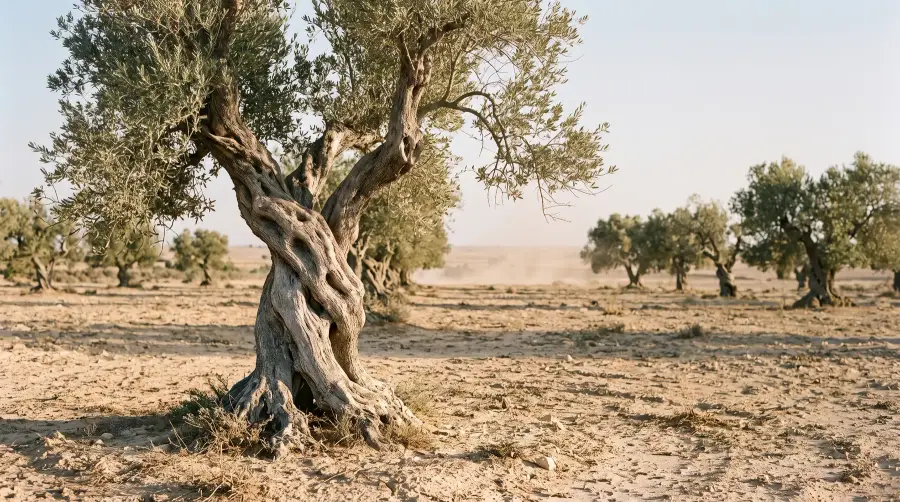
Sfax, 2019
ArtisRaw was founded in Sfax, at the heart of Tunisia’s largest olive forest. Here the Chemlali variety accounts for 69% of the country’s olive trees and 56% of its planted area. The trees stand twenty-four metres apart — a spacing that seems excessive until you understand why: without irrigation, every tree must send its roots far out to find water. That constraint is what shapes the wood.
Three partners founded the company, with skills that did not overlap and one shared standard: to manufacture here, from retired trees, products a professional buyer in Hamburg, Houston or Tokyo could put on a shelf without compromise.

Mohamed Bilel Cherif Co-founder & CEO, operations and strategy. He runs the factory the way you run a supply chain: capacity, lead times, and the promise that a reorder matches the one before it.

Ihsen Triki Co-founder & Head of Design, product and craft. He shapes the catalogue: every profile, every radius, every grading rule that decides whether a piece goes to the shelf or back to the bench.

Ahmed Sakka Co-founder, heritage and vision. He keeps the company tied to the groves, and to the families who have tended them for a century.
Working a material that refuses to be uniform
ArtisRaw’s challenge fits in one sentence: produce consistently from an inconsistent material.
A professional buyer needs predictability. Dimensions held, lead times met, reorders that match. Olive wood does not follow those rules. Every trunk has its own figure, its knots, its bark inclusions. It moves as it dries — and it moves differently depending on the direction of the grain.
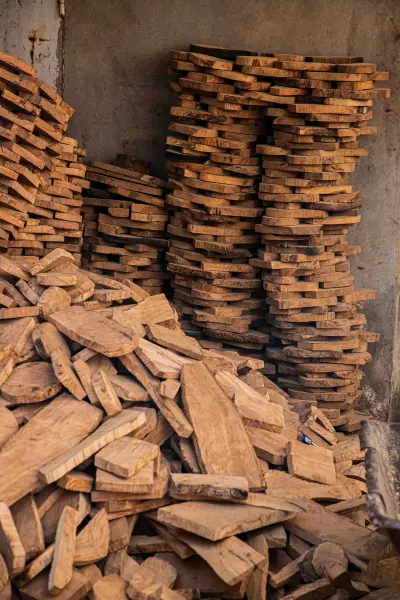
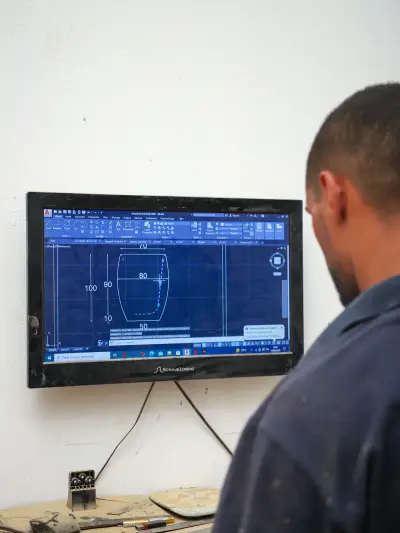
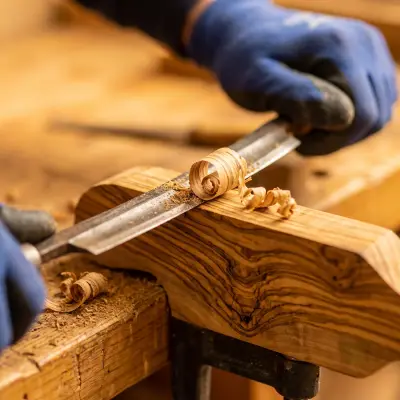
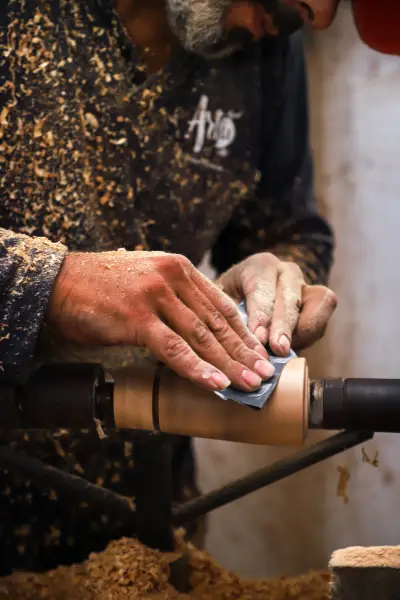
The workshop was built around a strict process to resolve that tension: wood selection, controlled drying, cutting, sanding, finishing with mineral oil and beeswax, final inspection. What fails inspection does not ship. Dimensions are held within stated tolerances, and the natural variation of the grain is explained to the buyer rather than hidden — because it is part of the product.
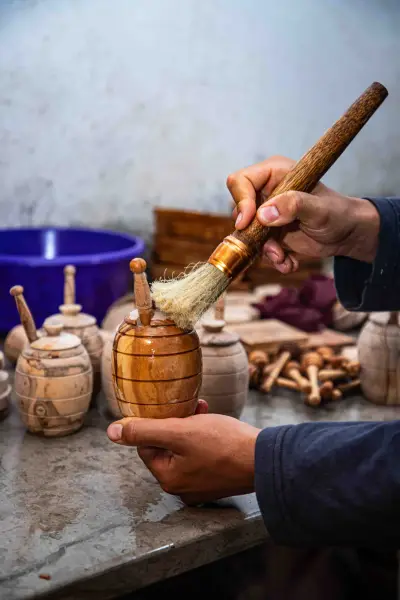
None of this is improvised. It is installed, measured, and corrected.
From the first container to certification
Founded in Sfax. Three founders, one workshop.
First full container to the European Union. A container is not a large order: it is proof. That the workshop can hold a rhythm, that an entire batch leaves at the same tolerances, that the export paperwork is right. It is the moment a craft operation becomes an export operation.
ASD Market Week, Las Vegas. Our first US trade show.
NY NOW, New York.
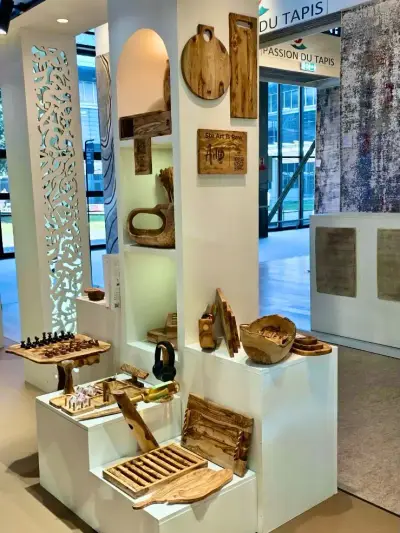
The principle that does not move
ArtisRaw cuts no living, productive tree.
The wood comes from olive trees at the end of their fruiting life, in groves worked under forestry licence, in the same region as the workshop. Reusable offcuts are recovered and reworked into smaller pieces.
This principle has a cost. It limits supply, forces us to work an uneven material, and rules out promising two identical pieces. We accept that, because it is the only honest way to sell century-old olive wood.
What we actually do
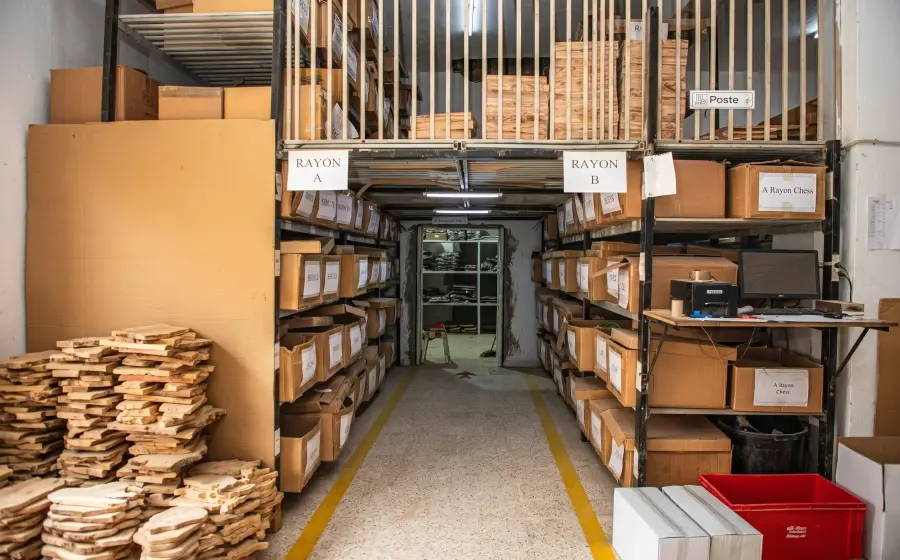
Eleven artisans. A 1,400 m² workshop. 776 SKUs across 12 families: cutting boards, utensils, bowls and baskets, trays and plates, jars and containers, tableware, chess and board games, decoration, bath and beauty, personalised gifts.
Our customers are retailers, distributors, importers, hospitality groups and private-label brands. Professionals who need clear minimum quantities, lead times that hold, export documents in order, and a reorder that matches the one before it.
Why it matters
A Chemlali olive tree takes a century to produce that grain. It grew slowly because it lacked water, and that slowness is what makes it dense. You cannot speed it up. You cannot reproduce it elsewhere. You cannot make it uniform.
Our work is to take that irregular material and draw a regular production out of it — without erasing what makes it singular.
That is ArtisRaw: craft, run like a factory.
See what that produces: olive wood wholesale from the manufacturer.