Chemlali olive wood: origin, sourcing, and what the research actually shows
BY THE ARTISRAW EDITORIAL TEAM · SEPTEMBER 2026 · 11 MIN READ
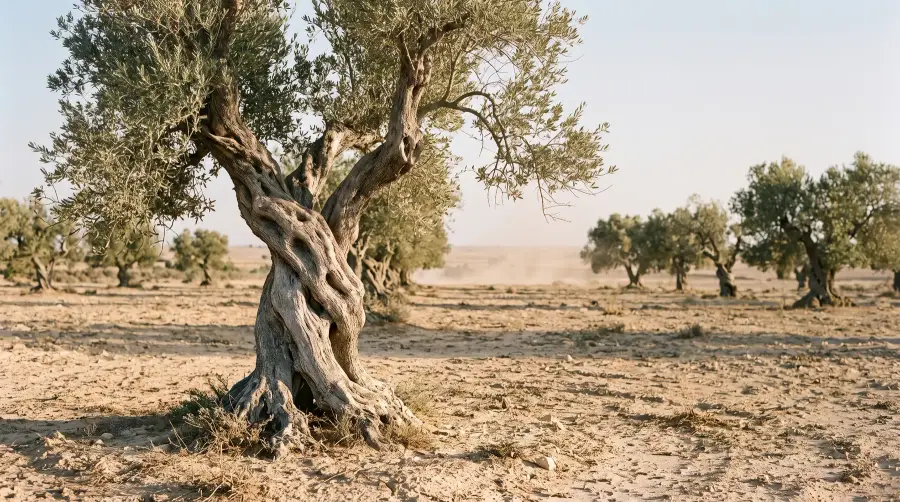
Old olive trees in the rain-fed groves of central Tunisia: unirrigated, widely spaced, and the source of this wood once they stop fruiting.
Chemlali olive wood is the timber of Chemlali olive trees, the cultivar that dominates Tunisia’s olive groves. Botanically it is Olea europaea, the same species as every other olive wood. On the evidence available today, what sets it apart is where it comes from and how it reaches a workshop: from old, rain-fed groves around Sfax, under a law that protects olive trees. No published study has yet shown a measurable difference in the wood itself.
This guide covers what Chemlali is, where it grows, why its wood is available at all, and what research has and has not established about it. We make olive wood products from Chemlali trees in Sfax, so we have an interest in the answer. That is why every statement below is sourced, and why we say clearly where the evidence runs out.
Chemlali olive wood at a glance
| QUESTION | ANSWER | SOURCE |
|---|---|---|
| Botanical species | Olea europaea L. | — |
| Cultivar | Chemlali Sfax, also known as Sahli | IOC World Catalogue of Olive Varieties; Scientia Horticulturae (2010) |
| Origin | Sfax region, central Tunisia; grown throughout the centre and south | IOC World Catalogue of Olive Varieties |
| Share of Tunisia’s olive trees | About 69% of trees and 56% of olive area (2013 figures) | IOC, citing CCIS (2013) |
| Typical grove | Traditional, rain-fed, very widely spaced: around 17 to 20 trees per hectare | IOC; Journal of Cleaner Production (2020) |
| Legal status of the trees | Felling or uprooting prohibited without authorisation (Law No. 61-20 of 1961) | ECOLEX |
| Where the wood comes from | Trees at the end of their fruiting life, trees being replaced, and pruning | The Wood Database; ArtisRaw |
| Published data on Chemlali trunk timber | Very limited; see below | — |
What is Chemlali?
Chemlali Sfax is Tunisia’s main oil-olive cultivar. The International Olive Council’s World Catalogue of Olive Varieties describes it as originating in the Sfax region and cultivated throughout the centre and south of the country. According to 2013 figures cited in that catalogue, it accounted for about 56% of Tunisia’s olive area and 69% of all its olive trees. It is a vigorous, self-fertile tree, valued by growers for its tolerance of drought and poor soils, although it is sensitive to olive knot, a disease caused by the bacterium Pseudomonas savastanoi.
One detail matters for anyone using the name precisely: “Chemlali” is not a single genetic line. Tunisian researchers have shown that several genetically distinct cultivars share the name according to their area of origin, among them Chemlali Sfax, Chemlali Zarzis and Chemlali Boughrara. The one that dominates the Sfax olive grove, and extends into the centre and the Sahel, is Chemlali Sfax, also known as Sahli. When we say Chemlali, we mean the trees of the Sfax region groves our wood comes from.
Where does Chemlali olive wood come from?
From the centre and south of Tunisia, and above all from Sfax. Tunisia has around 1.85 million hectares of olive groves. The Sfax region alone accounts for about 19% of that area and about 21.7% of national production, according to 2019 figures from the Tunisian agricultural statistics services.
The groves there are mostly traditional and rain-fed, with very low planting density: around 20 trees per hectare. In the classic layout that the IOC catalogue describes as the symbol of the “olive forest of Sfax”, trees stand 24 metres apart, at about 17 trees per hectare. Despite the name, this is farmland, not forest.
These are the growing conditions of the tree. Whether they produce measurably different timber has not, to our knowledge, been studied; see the comparison below.
ArtisRaw’s workshop is in Sfax and sources from Chemlali groves in the same region, so sourcing, cutting, finishing and packing all happen in one place. See our olive wood manufacturing in Sfax →
Why is Chemlali olive wood available if olive trees are protected?
Because it comes from trees that no longer produce, and it is taken under authorisation. Tunisia’s Law No. 61-20 of 31 May 1961, as amended by Law No. 2001-119, prohibits felling or uprooting olive trees without authorisation. When old trees reach the end of their fruiting life and are replaced, their wood becomes available, alongside wood from pruning. ArtisRaw sources only from trees past their fruiting life, under Tunisian Forestry Licence No. 4684.
The same logic applies across the Mediterranean. The Wood Database notes that healthy olive trees are rarely felled for lumber because the fruit is worth more. Italian researchers studying Calabrian cultivars point out that the pruning of mature olive trees produces large quantities of wood that is usually treated as waste or firewood (Mammoliti et al., 2024). Turning that wood into long-lived products is one of its better uses.
Is Chemlali olive wood different from Italian or Spanish olive wood?
Short answer: no published study has compared Chemlali wood with Italian or Spanish olive wood under the same conditions. Any claim that one of them is objectively better timber than the others is not supported by evidence today.
Here is what has been studied, and for which cultivars:
| ORIGIN AND CULTIVARS | WOOD STUDIES WE FOUND | WHAT WAS MEASURED | RELEVANCE TO KITCHENWARE |
|---|---|---|---|
| Tunisia: Chemlali | Ben Brahim et al. (2022); Molecules (2023) | Phenolic compounds in extracts of root bark and root wood | Roots, not the trunk and branch timber used for kitchenware |
| Tunisia: cultivar not stated | Dahmen et al. (2010), Faculté des Sciences de Sfax | Elastic constants of olive wood plates, by ultrasound | Mechanical behaviour; see our olive wood properties guide |
| Italy: Ottobratica and Sinopolese (Calabria) | Urso et al. (2024); Mammoliti et al. (2024) | Wood anatomy; stiffness, strength and hardness of stem and branch wood | Directly relevant, but different cultivars |
| Spain: ten cultivars, including Picual and Farga | Journal of Agricultural and Food Chemistry (2015) | Phenolic compounds in extracts of pruning wood | Chemistry only; Chemlali not included |
What the evidence does say:
- Variation within olive wood is large. The Italian anatomy study stresses how variable olive wood is and cautions that differences between its two cultivars need quantitative work before they can be called statistically valid (Urso et al., 2024). The Wood Database notes that olive wood quality varies widely and that there does not seem to be a consistent difference between wood from the different Mediterranean regions.
- Cultivar can matter, within a single study. In the Italian mechanical study, Sinopolese generally scored higher than Ottobratica for stiffness, strength and hardness, and branch wood scored higher than stem wood in most tests (Mammoliti et al., 2024). The Spanish study found significant differences in extract chemistry between cultivars. Neither included Chemlali.
- What differs verifiably between origins today is the supply chain: the age and type of tree, the legal framework, how the wood is dried and how it is graded. It is not a measured property of Chemlali timber.
What research exists on Chemlali specifically?
Chemistry, from roots. Ben Brahim, Priego-Capote and Bouaziz (2022) analysed ethanol extracts of Chemlali root bark and root wood and identified 14 phenolic compounds, mainly secoiridoids and flavonoids, with oleuropein the most abundant at up to 7,000 mg/kg. A 2023 study of Chemlali root extracts identified 40 compounds, of which 53% by number were secoiridoids. Both studies explore the biological activity of solvent extracts of ground root tissue. They do not describe the trunk and branch timber used for kitchenware, and they say nothing about a finished, oiled product.
Mechanics, from Sfax. In 2010, researchers at the Faculté des Sciences de Sfax measured all nine elastic constants of olive wood plates using air-coupled ultrasound (Dahmen et al., 2010). The paper’s abstract does not state the cultivar. We summarise the results in our olive wood properties guide.
The tree and its oil. The agronomy of Chemlali and the composition of its oil are extensively documented, including its drought tolerance and characteristic fatty-acid profile. That literature concerns the fruit and the tree, not the wood.
The gap. We have not found a published characterisation of Chemlali trunk or branch timber covering density, hardness, shrinkage, anatomy or heartwood chemistry. Given that Chemlali accounts for most of Tunisia’s olive trees, that is a notable gap.
Claims about Chemlali wood that the evidence does not support
You may find the statements below online, sometimes attributed to research. This is what the cited research actually shows.
| CLAIM | WHAT THE RESEARCH SHOWS |
|---|---|
| “Chemlali wood contains no flavonoids” | The Chemlali root studies found flavonoids alongside secoiridoids. No study we found analyses the heartwood of Chemlali trunk timber. |
| “Chemlali wood is 53% secoiridoids” | That figure is the share of compounds identified, by number, in root extracts. It is not a share of the wood’s mass. |
| “Chemlali olive wood is rich in oleuropein” | Oleuropein was measured in root extracts. We found no published measurement in the trunk and branch timber used for kitchenware. |
| “Chemlali is denser or harder than Italian or Spanish olive wood” | No comparative measurement exists. Olive wood as a whole averages about 980 kg/m³ (The Wood Database), and individual pieces vary. |
| “Chemlali’s narrow rays and low starch make it more mould-resistant than Italian cultivars” | We found no anatomical study of Chemlali wood. The Italian study itself warns against drawing cultivar conclusions given olive wood’s variability. |
| “Arid growth gives Chemlali wood tighter growth rings” | Plausible, but not measured for Chemlali timber. In olive wood, growth rings are often hard to distinguish at all. |
What distinguishes ArtisRaw’s Chemlali olive wood
The points we can document, and that a buyer can check:
- Origin: Chemlali groves in the Sfax region, with sourcing, cutting, finishing and packing on one site at Route Saltnia Km 4.5, Sfax.
- Legal basis: Tunisian Forestry Licence No. 4684; trees past their fruiting life; the framework of Law No. 61-20.
- Drying: air-dried, then kiln-dried to 10 ± 2% moisture content. Inside the kiln: why we dry to 10% →
- Grading: criteria locked per SKU, so reorders fall within the approved range.
- Quality system: ISO 9001:2015, Bureau Veritas, certificate n° 45.2025.0143, valid November 2025 to November 2028.
- Export documents: species and country of harvest for US Lacey Act declarations, EUDR traceability information for EU shipments, ISPM-15 heat-treated pallets, and the rest of the export documentation set out on our quality and certifications page.
Tunisian olive wood wholesale → · Quality and certifications → · How to care for it → · Request a quote →
How to verify a “Chemlali” claim when buying olive wood
- Ask for species and cultivar in writing, together with the region of harvest. A trade name is not a species, which is the same discipline that makes two “acacia” quotations comparable. Olive wood vs acacia vs bamboo, on published figures →
- Ask for the legal basis of the harvest: the authorisation or forestry licence under Tunisian law.
- For EU shipments, ask which EUDR traceability information the supplier provides. EUDR and olive wood: what EU buyers need in 2026 →
- For the US, check the data for the Lacey Act declaration: genus, species and country of harvest. Lacey Act basics →
- Treat technical claims as claims (density, chemistry, durability) until you see the test report and which part of the tree was measured. Our olive wood properties guide sets out what has actually been measured for the species.
- Rely on documents, not the label. As far as we know, no geographical indication or legal designation governs the name “Chemlali” on wood products.
The bottom line
Chemlali is a real, well-documented olive cultivar, deeply rooted in Sfax, and it accounts for most of Tunisia’s olive trees. Its wood is Olea europaea, like every other olive wood. The differences that can be verified today lie in origin, the age of the trees, the legal framework and the way the wood is processed. Claims that Chemlali is superior in density, chemistry or durability are not supported by published research. Until someone measures it, we would rather tell you what is known.
Frequently asked questions
What is Chemlali olive wood?
Chemlali olive wood is the timber of Chemlali olive trees, Tunisia’s main oil-olive cultivar, which originated in the Sfax region. Botanically it is Olea europaea, like all olive wood. It reaches the market from trees at the end of their fruiting life and from pruning, because Tunisian law prohibits felling olive trees without authorisation.
Where does Chemlali olive wood come from?
From central and southern Tunisia, above all the Sfax region, which holds about 19% of the country’s olive area. The groves are mostly traditional and rain-fed, with around 20 trees per hectare. According to 2013 figures, Chemlali accounted for about 69% of Tunisia’s olive trees.
Is Chemlali olive wood better than Italian or Spanish olive wood?
No published study has compared them under the same conditions. Olive wood varies widely from tree to tree, and The Wood Database finds no consistent difference between Mediterranean regions. What differs verifiably is the supply chain: tree age, legal framework, drying and grading, not a measured property of the timber.
Is Chemlali olive wood denser than other olive wood?
There is no published comparison. Olive wood as a whole averages about 980 kg/m³ when dry, according to The Wood Database, with a Janka hardness of about 2,710 lbf, and individual pieces vary. Density claims specific to Chemlali should come with a test report stating the sample and method.
Why can olive wood be harvested in Tunisia if olive trees are protected?
Law No. 61-20 of 1961 prohibits felling or uprooting olive trees without authorisation. Wood becomes available when old trees at the end of their fruiting life are replaced, and from pruning. ArtisRaw sources only from trees past their fruiting life, under Forestry Licence No. 4684.
Does Chemlali olive wood contain oleuropein?
Oleuropein has been measured in extracts of Chemlali root bark and root wood, at up to 7,000 mg/kg in one study. We found no published measurement in the trunk and branch timber used for kitchenware, so no property of finished products should be inferred from those root studies.
How can I check that olive wood is really Chemlali?
Ask the supplier for the species, cultivar and region of harvest in writing, the legal basis of the harvest, EUDR traceability information for EU shipments and Lacey Act data for the US. As far as we know, no legal designation governs the name Chemlali on wood, so documents matter more than labels.
Sources
- International Olive Council. World Catalogue of Olive Varieties: Chemlali Sfax (Tunisia). worldolivecatalogue.internationaloliveoil.org
- Compositional quality of virgin olive oils from cultivars introduced in Tunisian arid zones in comparison to Chemlali cultivars. Scientia Horticulturae (2010). ScienceDirect
- Evaluation of the environmental sustainability in the olive growing systems in Tunisia. Journal of Cleaner Production (2020). ScienceDirect
- Republic of Tunisia. Law No. 61-20 of 31 May 1961 prohibiting the felling and uprooting of olive trees, as amended by Law No. 2001-119. ECOLEX record
- The Wood Database. Olive (Olea europaea). wood-database.com/olive. Accessed September 2026.
- Ben Brahim, S., Priego-Capote, F., & Bouaziz, M. (2022). Use of high-performance liquid chromatography/electrospray ionization mass spectrometry for structural characterization of bioactive compounds in the olive root bark and wood of Chemlali cultivar. ACS Omega, 7(38), 33873–33883. doi:10.1021/acsomega.2c02746
- Comprehensive metabolite profiling of Chemlali olive tree root extracts using LC-ESI-QTOF-MS/MS, their cytotoxicity, and antiviral assessment. Molecules (2023), 28(12), 4829. doi:10.3390/molecules28124829
- Dahmen, S., Ketata, H., Ben Ghozlen, M. H., & Hosten, B. (2010). Elastic constants measurement of anisotropic Olivier wood plates using air-coupled transducers generated Lamb wave and ultrasonic bulk wave. Ultrasonics, 50(4–5), 502–507. doi:10.1016/j.ultras.2009.10.014
- Urso, T., Zanetti, M., Magnabosco, A., Mammoliti, A., Paccagnella, M., & Proto, A. R. (2024). Qualitative wood anatomy study of Ottobratica and Sinopolese cultivars of Olea europaea L. Forests, 15(11), 2001. doi:10.3390/f15112001
- Mammoliti, A., Cataldo, M. F., Papandrea, S. F., & Proto, A. R. (2024). Mechanical properties of branch and stem wood for two Mediterranean cultivars of olive tree. Journal of Wood Science, 70(1). doi:10.1186/s10086-024-02153-1
- Phenolic components and antioxidant activity of wood extracts from 10 main Spanish olive cultivars. Journal of Agricultural and Food Chemistry (2015). PubMed 26154988
About ArtisRaw. ArtisRaw (STE ART IS RAW) manufactures handmade Chemlali olive wood kitchenware, tableware and décor in Sfax, Tunisia, for retailers, distributors, hospitality groups and private-label brands. Its quality management system is certified ISO 9001:2015 by Bureau Veritas, certificate n° 45.2025.0143, valid November 2025 to November 2028. Route Saltnia Km 4.5, Sfax, Tunisia.