Inside the kiln: why olive wood is dried to 10 ± 2%, and what that is worth in millimetres
BY THE ARTISRAW EDITORIAL TEAM · AUGUST 11, 2026 · UPDATED OCTOBER 6, 2026 · 9 MIN READ
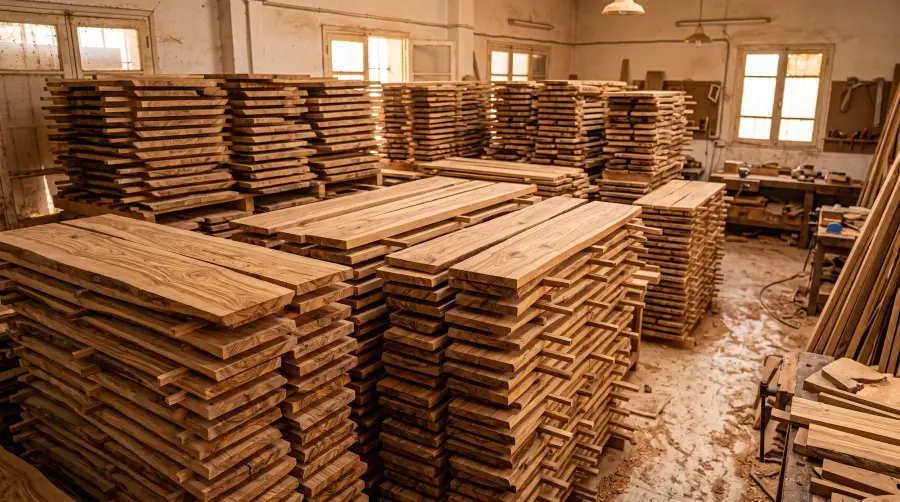
Stacked and stickered, with air on every face. Most of the water leaves here, slowly, before the kiln takes the last stretch.
We dry olive wood to 10 ± 2% moisture content before a piece is cut, because published interior conditions — 30 to 50% relative humidity — put wood at 6 to 9%, so a piece that leaves at 10 ± 2% has only two or three percentage points left to travel in a customer’s building. On a 300 mm board, each percentage point is worth about 0.8 mm across the grain. Three points is a tolerance. Nine points, which is what shipping at 16% means for a heated store in winter, is roughly 7 mm of movement and a cupped board.
Almost every complaint a buyer will ever have about a wooden product is a moisture complaint wearing a different coat. This guide shows the arithmetic behind the specification, what happens either side of the band, how the wood gets there, and how it is checked.
Wood does not stop moving when it is cut
Timber is hygroscopic: it takes on and gives up moisture until it is in equilibrium with the air around it, and it changes size as it does. The movement is not even. Wood moves most across the grain, much less along the radius, and the difference between those two is what turns a flat board into a curved one.
A piece that leaves a workshop at the moisture content of a Mediterranean summer and arrives in a heated European warehouse in January has to lose water, and it will lose it whether or not the shape survives. The question a specification answers is how much is left to lose.
What one percentage point is worth, in millimetres
The published green-to-oven-dry shrinkage for Olea europaea is 4.9% radial and 7.7% tangential. Those figures cover the whole journey from fibre saturation — conventionally taken at about 30% moisture content, below which wood starts to shrink — down to oven dry. Treating shrinkage as linear across that span, which is the standard working assumption, gives:
- Tangential (across the grain, the width of a flat-sawn board): 7.7% ÷ 30 ≈ 0.26% per 1% moisture content.
- Radial: 4.9% ÷ 30 ≈ 0.16% per 1% moisture content.
Multiply by a width and the specification stops being abstract:
| BOARD WIDTH | PER 1% MC | 10% → 7% (3 POINTS) | 16% → 7% (9 POINTS) |
|---|---|---|---|
| 150 mm | 0.39 mm | 1.2 mm | 3.5 mm |
| 200 mm | 0.51 mm | 1.5 mm | 4.6 mm |
| 300 mm | 0.77 mm | 2.3 mm | 6.9 mm |
| 400 mm | 1.03 mm | 3.1 mm | 9.2 mm |
Tangential movement only, derived from the published 7.7% figure as described above. Real pieces vary with the cut, the tree and whether the wood came from trunk or branch, so read these as the order of magnitude, not as a guarantee.
Two things follow. First, our cut tolerance of ±1 mm is tighter than the movement a three-point moisture change produces on a wide board — which is why moisture content, not machining, is the specification that decides whether a piece still fits its lid in February. Second, the same arithmetic explains why uneven drying is so destructive: if one face loses three points and the other loses one, the board has to curve.
Why ten, and not more or less
The target band is chosen against the conditions the products actually live in.
| WHERE THE WOOD IS | MOISTURE CONTENT | WHAT IT MEANS |
|---|---|---|
| Freshly cut, before drying | well above 30% | Above fibre saturation: no shrinkage yet, all the movement still to come |
| After air drying alone, in this climate | 14–18% | Still four to eleven points above where it will end up indoors |
| ArtisRaw target before cutting | 10 ± 2% | Two or three points from an indoor equilibrium, in either direction |
| Heated or air-conditioned interior at 30–50% RH | 6–9% | Where a kitchen or a shop floor actually sits for most of the year |
| Cold-climate interior in deep winter | below 6% | Drier than most specifications assume; the case for acclimatising stock before display |
| Humid summer without air conditioning | above 9% | The wood takes moisture back on; the movement runs the other way |
Aim higher than the band and the wood still has a long way to travel once it is indoors: it will shrink after it has been shaped, which is when shrinkage shows as a crack or a warp rather than as a smaller blank. Aim much lower and two things happen: the wood becomes brittle to work and more likely to check during machining, and it takes moisture back on anyway in any normal room — so the extra drying buys nothing and costs stability.
Ten per cent, with a tolerance either side, is the compromise: dry enough that the remaining movement is small, wet enough that the piece is still pleasant to carve and does not fight the tools.
How the wood gets there
| STAGE | WHAT HAPPENS | MEASURABLE TARGET |
|---|---|---|
| Intake | Timber from pruning and from non-productive trees taken out of the grove. Olive is dense and full of tension, so it is cut into manageable sections early. | Sections sized so that no piece has to lose water through more thickness than it must |
| Air drying | Stacked and stickered under cover, with air on every face, for months. This is where most of the water leaves, slowly enough that the wood does not tear itself. | down to 14–18% |
| Kiln | The last stretch, under control. Slow schedules: olive punishes haste with checking. | 10 ± 2% |
| Conditioning | The stack is allowed to even out — the outside of a board dries faster than its core. | Core and surface readings converged before cutting |
| Check | Moisture measured on the stack, with a meter, before anything is cut. | Inside the band, or the batch waits |
What it means for a buyer
It means the piece you receive has already done most of the moving it is ever going to do, and that the movement left in it is within what a finish and a sensible design can absorb. It also means two practical things for your warehouse and your shop floor:
- Let new stock acclimatise unwrapped for a few days before display, away from heaters, air vents and sunny windows. A slow change is a safe change — especially when a shipment arrives in a heated store in winter.
- Specify the number on the purchase order. “Kiln dried” is not a specification; 10 ± 2% is. The care routine that keeps it there →
Natural variation is a different thing and does not go away with drying. Grain, colour and figure differ from tree to tree and from cut to cut, and dimensions are nominal because every piece is shaped by hand. That is the material, not a defect — and it is worth telling the shop floor so, because a customer who understands it buys with more confidence. How olive compares with acacia and bamboo on movement →
Where this sits in quality control
Drying is checked as part of the quality management system certified to ISO 9001:2015, certificate n° 45.2025.0143, issued by Bureau Veritas Certification. The certificate does not test the wood; it tests that the procedure exists, is followed, and is improved when it fails. For a step whose result only shows up months later in someone else’s warehouse, that is exactly the sort of discipline that matters. Quality and certifications → · Inside the factory →
The properties behind all of this — density, hardness, the shrinkage figures used above — are set out with their sources in our olive wood properties guide, and what is specific to the cultivar we work is in the Chemlali guide.
Frequently asked questions
What moisture content should olive wood ship at?
For kitchenware and tableware heading to heated indoor markets, 10 ± 2% is the band to specify, and it is what we dry to before a piece is cut. The reason is arithmetic rather than preference: published interior conditions of 30–50% relative humidity put wood at 6–9% moisture content, so a piece leaving at 10 ± 2% has only two or three points left to travel. A piece leaving at 16% has nine.
Why 10% and not 8% or 14%?
Because both ends cost you something. Air drying alone in this climate stops around 14 to 18%, which leaves the wood to shrink after it has been shaped — and shrinkage after finishing shows up as a crack or a warp rather than as a smaller blank. Take it much below 8% and the wood becomes brittle to machine, more likely to check, and it will take moisture back on in any normal room anyway. Ten per cent with a tolerance either side is the compromise.
How much does olive wood move for each percentage point of moisture?
About 0.26% of its width across the grain, and 0.16% along the radius. Those come from the published green-to-oven-dry shrinkage figures — 7.7% tangential and 4.9% radial — spread over the roughly 30 points between fibre saturation and oven dry. On a 300 mm board that is about 0.8 mm of width per percentage point, which is why a four-point change is a tolerance and a nine-point change is a complaint.
What happens if wooden kitchenware is shipped too wet?
It shrinks in the customer’s building instead of in the workshop. A 300 mm board that leaves at 16% and settles at 7% in a heated store in winter loses roughly 7 mm across its width, and because the surface dries faster than the core, that movement is uneven: the board cups, fine checks open at the ends, and glue lines and fittings on assembled pieces work loose. None of it is visible on the day it is packed.
Is kiln-dried olive wood better than air-dried?
Neither alone does the job; the sequence is what matters. Months of air drying under cover removes most of the water slowly enough that dense, tense olive wood does not tear itself, and the kiln then takes the last stretch under control down to the target band. Kiln-only drying of olive risks checking; air-only drying stops too wet for an indoor product. We do both, in that order.
How is the moisture content checked?
With a meter, on the stack, after the stack has been allowed to even out — the outside of a board dries faster than its core, so a reading taken straight out of the kiln flatters the batch. Readings are taken before anything is cut, and the check is part of the quality management system certified to ISO 9001:2015, certificate n° 45.2025.0143, issued by Bureau Veritas.
Will a board still move after it arrives?
Yes, a little, and that is normal for every solid wood. A piece dried to 10 ± 2% has done most of the moving it will ever do, and what is left is within what a finish and a sensible design absorb. The way to keep it there is to let new stock acclimatise unwrapped for a few days before display, away from heaters and vents, and to re-oil it when the surface stops beading water.
Does drying prevent cracking completely?
No, and any supplier who says otherwise is selling you a promise rather than a specification. Drying controls how much movement is left in the piece; the customer’s treatment decides whether that movement happens evenly. A dishwasher, a soak in the sink or a radiator will crack a correctly dried board, because they change its moisture faster on one face than the other.
Sources
- The Wood Database. Olive (Olea europaea) — shrinkage 4.9% radial, 7.7% tangential, 12.8% volumetric; density 980 kg/m³; the high-movement, poor-stability rating. wood-database.com/olive. Accessed October 2026.
- Published equilibrium moisture content guidance for interior environments: wood sits at roughly 6–9% moisture content at 30–50% relative humidity, lower in cold-weather interiors and higher in humid summers. Derived from standard EMC tables as used in wood-moisture practice (Wagner Meters, Lignomat), which follow the USDA Forest Service Wood Handbook.
- The per-percentage-point figures are arithmetic, not measurements: the published shrinkage divided by the roughly 30 percentage points between fibre saturation and oven dry, with shrinkage taken as linear across that span.
- ArtisRaw workshop: 10 ± 2% target before cutting, 14–18% after air drying in this climate, ±1 mm cut tolerance, drying checked under the ISO 9001:2015 quality management system, certificate n° 45.2025.0143, Bureau Veritas.
About ArtisRaw. ArtisRaw (STE ART IS RAW) manufactures handmade Chemlali olive wood kitchenware, tableware and décor in Sfax, Tunisia, for retailers, distributors, hospitality groups and private-label brands. Its quality management system is certified ISO 9001:2015 by Bureau Veritas, certificate n° 45.2025.0143, valid November 2025 to November 2028. Route Saltnia Km 4.5, Sfax, Tunisia.
Put the number on the order: 10 ± 2% moisture content, ±1 mm on cut dimensions.
Request a wholesale quote