Olive wood properties: density, hardness, grain, and what the science really says
BY THE ARTISRAW EDITORIAL TEAM · SEPTEMBER 2026 · 12 MIN READ
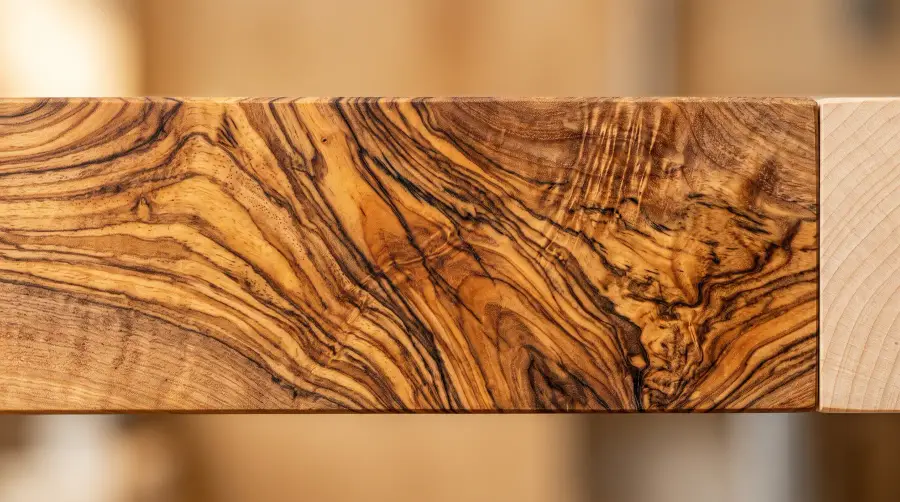
Olive wood’s figure comes from colour — dark streaks and veins through a yellow to reddish-brown heartwood — rather than from open pores.
Olive wood is the timber of the olive tree, Olea europaea L. It is one of the densest and hardest woods used for kitchenware: around 980 kg/m³ when dry and 2,710 lbf (12,060 N) on the Janka hardness scale, nearly twice as hard as hard maple, the traditional cutting-board timber. Its fine, diffuse-porous texture and its yellow to reddish-brown heartwood, streaked with dark brown and black, mean that no two pieces look the same.
This guide sets out what has actually been measured about olive wood (density, hardness, stiffness, anatomy and movement) and traces every figure to its source. It also separates what research has shown from what is often repeated online. We make olive wood products in Sfax, Tunisia. Where our own process is relevant we describe it, and where the evidence stops, we say so.
Olive wood at a glance
| PROPERTY | OLIVE WOOD (OLEA EUROPAEA) | SOURCE |
|---|---|---|
| Botanical family | Oleaceae | The Wood Database |
| Average dried weight (12% moisture content) | about 980 kg/m³ (61.2 lb/ft³) | The Wood Database |
| Specific gravity (basic / at 12% MC) | 0.81 / 0.98 | The Wood Database |
| Janka hardness | 2,710 lbf (12,060 N) | The Wood Database |
| Porosity | Diffuse-porous; small, numerous vessels, mostly in radial multiples | The Wood Database |
| Shrinkage, green to oven-dry | Radial 4.9% · Tangential 7.7% · Volumetric 12.8% | The Wood Database |
| Stiffness along vs across the grain | About 2.4 to 1 (ultrasonic measurement) | Dahmen et al., 2010 |
| Typical supply | Pruning and end-of-life orchard trees, not trees felled for lumber | The Wood Database; Tunisian Law No. 61-20 |
What is olive wood?
Olive wood is the hardwood of the cultivated olive tree, a Mediterranean species grown for its fruit and oil for thousands of years. Because a productive olive tree is worth far more for its olives than for its timber, healthy trees are rarely cut for lumber. Olive wood reaches the market mainly from pruning, from storm-damaged or diseased trees, and from trees at the end of their productive life.
In Tunisia this is also a legal matter. Felling or uprooting olive trees without authorisation is prohibited under Law No. 61-20 of 31 May 1961, as amended by Law No. 2001-119. ArtisRaw works olive wood from Chemlali trees, the main oil-olive cultivar of the Sfax region, once they have reached the end of their fruiting life, and sources it under Tunisian Forestry Licence No. 4684. How our olive wood is sourced →
Two names cause confusion. Russian olive (Elaeagnus angustifolia) is an unrelated tree in a different botanical family. East African olive (Olea capensis) is a close relative whose wood is hard to tell apart from Olea europaea, but it is not grown for olives. When a supplier offers “olive wood”, it is fair to ask for the species and the country of harvest: a US Lacey Act declaration requires both. How to check the material itself → Importing olive wood to the USA: Lacey Act basics →
How dense and hard is olive wood?
Olive wood averages about 980 kg/m³ at 12% moisture content, roughly 40% heavier than hard maple, and its Janka hardness of 2,710 lbf is nearly twice maple’s 1,450 lbf. In practice, that means it dents and scores less in daily use, and a board sits heavily and steadily on the counter.
| PROPERTY (THE WOOD DATABASE) | OLIVE (OLEA EUROPAEA) | HARD MAPLE (ACER SACCHARUM) |
|---|---|---|
| Average dried weight | 980 kg/m³ | 705 kg/m³ |
| Janka hardness | 2,710 lbf (12,060 N) | 1,450 lbf (6,450 N) |
| Modulus of rupture (bending strength) | 143.0 MPa | 109.0 MPa |
| Elastic modulus (bending stiffness) | 12.39 GPa | 12.62 GPa |
| Crushing strength | 68.7 MPa | 54.0 MPa |
| Shrinkage: radial / tangential / volumetric | 4.9% / 7.7% / 12.8% | 4.8% / 9.9% / 14.7% |
Three points are worth reading carefully:
- Hardness and density are where olive wood stands out. In bending stiffness, olive and hard maple are practically level, so the claim that olive is “far stiffer than maple” is not supported by these figures.
- These are typical values, not specifications. The Wood Database notes that some of its olive strength data come from the subspecies cuspidata, and olive wood varies a great deal from tree to tree.
- Density has a logistics cost. A heavier board weighs more per unit shipped, which matters most by air freight. Sea vs air vs courier: landed-cost maths for wood products →
What gives olive wood its grain?
Olive wood is diffuse-porous: its pores are small, numerous and spread evenly through each growth ring, which gives it a fine, uniform texture. Its dramatic figure comes from colour rather than open pores: yellow to light reddish-brown heartwood with dark brown to black streaks and veins, a paler yellowish sapwood, and grain that may be straight, interlocked or wild. The colour deepens with age.
Under the microscope:
- Vessels are small to medium, numerous, and mostly grouped in short radial rows (radial multiples). Yellowish deposits inside them are common.
- Parenchyma forms thin sheaths around the vessels (vasicentric) and is often barely visible.
- Rays are narrow. A 2024 study of two Italian cultivars from Calabria, Ottobratica and Sinopolese, found rays typically one to two cells wide, as expected for the species, but also some three cells wide, together with starch deposits in the ray cells. The authors stress how variable olive wood is (Urso et al., 2024).
That study did not examine Chemlali, and differences between cultivars are not yet established, so the features above describe the species rather than any one variety.
What this means in the workshop and on the shelf:
- Every piece is different. Heartwood colour, dark streaking and the pale sapwood band vary from tree to tree. For a wholesale programme, the useful question is not “will pieces match?” but “what variation is inside the grade?” We lock grading criteria per SKU so that reorders fall within the approved range. Olive wood wholesale programmes →
- Fine texture finishes well. Small, evenly spread pores allow olive wood to be sanded to a very smooth surface. We sand from 80 to 400 grit and finish by hand with mineral oil and beeswax.
- Wild grain needs sharp tools and patience. Interlocked and wild grain can tear out during machining, which is one reason olive wood pieces are still shaped and finished largely by hand.
How stiff is olive wood? Measurements made in Sfax
The most complete stiffness data for olive wood were produced in Sfax, the same city as our workshop. In 2010, researchers at the Laboratoire de Physique des Matériaux of the Faculté des Sciences de Sfax published all nine elastic constants of olive wood, measured without contact using air-coupled ultrasound (Dahmen, Ketata, Ben Ghozlen and Hosten, 2010).
Their method sent Lamb waves along thin olive wood plates and measured how the wave speed changed with frequency, both parallel and perpendicular to the fibres. A numerical inversion recovered seven of the nine constants with an uncertainty of about 15%; the remaining two came from bulk ultrasonic wave measurements.
| ELASTIC CONSTANT | DIRECTION | REPORTED VALUE |
|---|---|---|
| C33 | Along the fibre | ≈ 10.8 GPa |
| C11 | Across the fibre | ≈ 4.35 GPa |
| C22 | Across the fibre, second axis | ≈ 4.51 GPa |
| C55 | Shear, longitudinal plane | ≈ 1.12 GPa |
| C66 | Shear, cross-section plane | ≈ 0.95 GPa |
These are components of a stiffness tensor derived from ultrasonic tests, not the bending modulus quoted in timber tables, so the two sets of numbers should not be compared directly.
Two findings matter. First, olive wood is roughly 2.4 times stiffer along the grain than across it. Second, the plane perpendicular to the fibres behaves approximately the same in every direction (C11 ≈ C22, C44 ≈ C55, C13 ≈ C23), although the authors note a significant difference between C13 and C23.
What this means, and what it does not:
- Grain direction matters for long, slender pieces. Spoons, spatulas and handles should be cut with the grain running along their length, which is standard practice in our workshop and across the craft.
- Stiffness is not stability. Elastic constants describe how wood responds to a load, not how much it moves when humidity changes. Movement depends on shrinkage and moisture content, covered next.
Does olive wood crack or warp?
It can, if it is dried badly or repeatedly soaked and dried. The Wood Database rates olive as having high movement in service and poor stability, especially when branch wood is used, and notes that checks and warping can occur during drying. Its average shrinkage figures (4.9% radial, 7.7% tangential, a tangential-to-radial ratio of 1.6) look moderate on paper, but irregular grain and branch wood make its movement less predictable than those averages suggest.
That is why drying is the single most important step in olive wood production. We air-dry and then kiln-dry our wood to 10 ± 2% moisture content before it is cut. Inside the kiln: why we dry to 10% →
Once a piece is dry and finished, the common causes of cracking are repeated soaking, dishwasher cycles and direct heat. The care routine further down addresses all three.
Is olive wood good for cutting boards and kitchen utensils?
For most kitchen and table uses, yes. Olive wood’s hardness resists knife scoring and dents, its fine texture finishes smooth, and its weight keeps a board steady while you work. It is especially well suited to serving and charcuterie boards, bread and cheese boards, spoons, spatulas, and mortars and pestles.
The trade-offs are worth stating plainly:
- Weight. A large olive wood board is heavy, which matters on busy prep stations and in shipping.
- Feel under the knife. Hardness cuts both ways: a harder surface resists scoring, but it gives less under the edge than a medium-hardness wood such as maple.
- Maintenance. Olive wood needs hand washing and periodic oiling. It is not for the dishwasher.
- Variation. Colour and figure differ from piece to piece. That is part of the appeal, but it has to be accepted within the grade.
For comparisons with other common board materials, read Olive wood vs acacia vs bamboo: a buyer’s comparison. For wholesale ranges, browse olive wood cutting boards and olive wood spoons and spatulas.
How to care for olive wood
Olive wood lasts for years when it is kept out of standing water and re-oiled as it dries out. The short version:
- Wash by hand in warm, soapy water straight after use.
- Towel-dry, then stand the piece on its edge so both faces dry evenly.
- Never put it in the dishwasher and never leave it to soak.
- Do not microwave it: rapid heating can dry dense wood unevenly, crack it and damage the finish.
- Re-oil when the surface looks pale or dry, using mineral oil or a mineral oil and beeswax blend, the same type of finish we apply.
- Keep it away from radiators, ovens and direct sun.
Water, heat and fast drying are what make wood swell, raise its grain and check. For the full routine, including how often professional kitchens re-oil pieces in service, read How to care for olive wood utensils: the professional guide.
Is olive wood sustainable? Sourcing, FSC and EUDR
Olive wood is a by-product of fruit growing rather than a forestry crop, and in Tunisia olive trees are protected by law. ArtisRaw’s supply rests on three documented elements:
- Legal sourcing. Chemlali trees at the end of their fruiting life, taken under Tunisian Forestry Licence No. 4684, within the framework of Law No. 61-20 on the protection of olive trees.
- Traceability for the EU. For EU shipments, we supply the traceability information that EU operators need for their EU Deforestation Regulation (EUDR) due-diligence statement. EUDR and olive wood: what EU buyers need in 2026 →
- Reuse. Wood offcuts from production are reused rather than sent to landfill.
What about FSC? FSC certification is designed for forest management. Our olive wood comes from agricultural groves, not from forests, so FSC is not the framework that governs this supply chain. Traceability is documented instead through the forestry licence and the EUDR information above. We would rather explain that than leave the question open.
Buying olive wood wholesale: what to specify
If you source olive wood for retail, distribution, hospitality or private label, these are the points worth writing into a purchase order:
- Species and origin: Olea europaea, with the country of harvest (Tunisia), as required for a US Lacey Act declaration.
- Moisture content: ours is dried to 10 ± 2%.
- Finish: ours is mineral oil and beeswax, applied by hand.
- Grade and figure tolerance: the acceptable range of colour, streaking and sapwood, agreed against reference photos.
- Dimensional tolerance: ours is ±1 mm on cut dimensions.
- Packing and documents: ISPM-15 heat-treated pallets, the ISO 9001:2015 certificate, EUDR traceability information for EU shipments, and the export documentation set out on our quality and certifications page.
Request a wholesale quote → · Start a private-label project → · Quality and certifications →
The bottom line
Olive wood’s measurable strengths are its density and its hardness, together with a fine texture that finishes beautifully. Its weaknesses, movement and maintenance, are real but manageable through controlled drying and a simple care routine.
Frequently asked questions
What is olive wood?
Olive wood is the timber of the olive tree, Olea europaea. It is a dense, hard, fine-textured hardwood with yellow to light reddish-brown heartwood and dark streaks. Because olive trees are grown for their fruit, the wood comes mainly from pruning and from trees at the end of their productive life rather than from felling for lumber.
How hard is olive wood?
Olive wood has a Janka hardness of about 2,710 lbf (12,060 N), according to The Wood Database, nearly twice that of hard maple at 1,450 lbf. It averages around 980 kg/m³ when dry, which makes it one of the densest woods commonly used for kitchenware.
Does olive wood float or sink?
A typical dry piece floats, but only just. Olive wood averages about 980 kg/m³ at 12% moisture content, slightly below the density of fresh water at 1,000 kg/m³. Because density varies from tree to tree, an unusually dense piece may sit very low in the water or sink.
Is olive wood good for cutting boards?
Yes. Its hardness resists knife scoring, its fine texture takes a smooth finish, and its weight keeps a board steady. The trade-offs are weight, the need for hand washing and regular oiling, and natural variation in colour and figure. It suits serving, bread, cheese and everyday preparation.
Can olive wood go in the dishwasher?
No. Hot water, detergent and long wet cycles swell the fibres, raise the grain, strip the oil finish and can crack the piece. Wash olive wood by hand in warm, soapy water, towel-dry it, stand it upright to dry, and re-oil it when it looks dry.
Why does olive wood crack?
Usually because of moisture. Olive wood moves noticeably as humidity changes, especially branch wood, so poor drying, soaking, dishwashers and direct heat can cause checks. Drying to a controlled moisture content (we target 10 ± 2%) and regular oiling reduce the risk.
Is olive wood FSC certified?
FSC certifies forest management. ArtisRaw’s olive wood comes from agricultural olive groves in Tunisia, not from forests, from trees at the end of their fruiting life, under Forestry Licence No. 4684 and Tunisian olive-tree protection law. Traceability is documented through that licence and the information we provide for EU Deforestation Regulation due diligence.
Sources
- Dahmen, S., Ketata, H., Ben Ghozlen, M. H., & Hosten, B. (2010). Elastic constants measurement of anisotropic Olivier wood plates using air-coupled transducers generated Lamb wave and ultrasonic bulk wave. Ultrasonics, 50(4–5), 502–507. doi:10.1016/j.ultras.2009.10.014
- Urso, T., Zanetti, M., Magnabosco, A., Mammoliti, A., Paccagnella, M., & Proto, A. R. (2024). Qualitative wood anatomy study of Ottobratica and Sinopolese cultivars of Olea europaea L. Forests, 15(11), 2001. doi:10.3390/f15112001
- The Wood Database. Olive (Olea europaea). wood-database.com/olive. Accessed September 2026.
- The Wood Database. Hard maple (Acer saccharum). wood-database.com/hard-maple. Accessed September 2026.
- Republic of Tunisia. Law No. 61-20 of 31 May 1961 prohibiting the felling and uprooting of olive trees, as amended by Law No. 2001-119. ECOLEX record
About ArtisRaw. ArtisRaw (STE ART IS RAW) manufactures handmade Chemlali olive wood kitchenware, tableware and décor in Sfax, Tunisia, for retailers, distributors, hospitality groups and private-label brands. Its quality management system is certified ISO 9001:2015 by Bureau Veritas, certificate n° 45.2025.0143, valid November 2025 to November 2028. Route Saltnia Km 4.5, Sfax, Tunisia.