How to care for olive wood: clean, oil and restore it, the science-based guide
BY THE ARTISRAW EDITORIAL TEAM · JUNE 15, 2026 · UPDATED OCTOBER 6, 2026 · 18 MIN READ
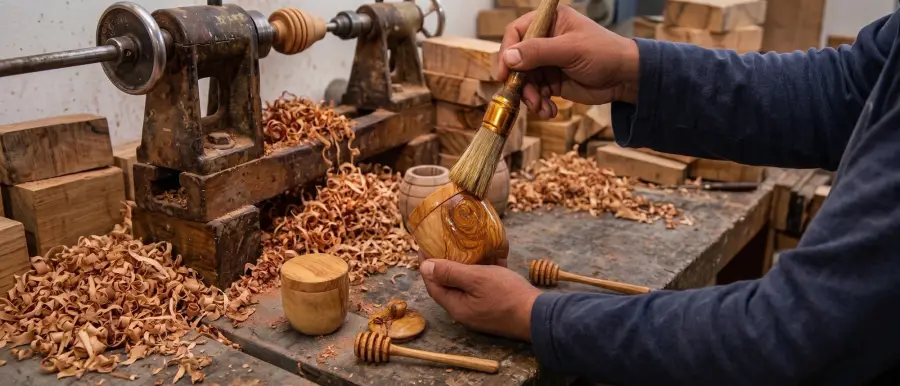
Mineral oil and beeswax, brushed on by hand: the finish every ArtisRaw piece leaves the workshop with, and the one to top up.
In short
Olive wood lasts for years when it is kept out of standing water and heat, dried upright, and re-oiled before it turns pale. Five habits do almost all the work:
- Wash by hand in warm water with mild soap, towel it dry at once, and stand it on its edge to finish drying.
- Never soak it and never put it in a dishwasher, microwave or oven.
- Re-oil about once a month (weekly in busy professional kitchens) with pure mineral oil sold for wooden boards, then a thin beeswax balm. Never use olive, sunflower or other cooking oils.
- Revive a pale or rough piece by sanding with 240 then 400 grit and re-oiling twice over two days.
- Let new stock acclimatise unwrapped before display, away from heaters, air vents and direct sun.
The reason is physics, not fussiness. Olive wood is dense (about 980 kg/m³) and hard (Janka 2,710 lbf), but like all wood it swells when it takes up water and shrinks when it dries. It also moves about 1.6 times more in one direction than the other, and that uneven movement is what warps and cracks a neglected piece. Our olive wood properties guide sets out the figures and their sources.
These rules are for oil-and-wax finished olive wood, which covers ArtisRaw kitchenware. Varnished décor and pieces combined with epoxy resin need different care, explained below.
Olive wood care schedule
Most olive wood needs two minutes after each use and five minutes of oiling about once a month. The table sets out every task by when it falls due.
| WHEN | WHAT TO DO | DETAILS |
|---|---|---|
| After every use | Hand wash in warm soapy water, towel dry, stand on its edge | How to clean olive wood |
| Every 5–7 washes, or about once a month | Re-oil with mineral oil, then a thin beeswax balm | What oil to use |
| Weekly | Same re-oil for kitchenware in daily or professional use | For chefs |
| Whenever water stops beading or the wood looks pale | Re-oil straight away | What oil to use |
| When the surface is rough, stained or sticky | Sand 240 then 400 grit, oil twice over two days, wax | How to restore olive wood |
| On arrival of new stock | Unwrap, inspect, let it acclimatise for a few days | For retailers |
| Monthly, for display stock | Check every piece and re-oil any that look pale | For retailers |
Why olive wood cracks and warps: the science
Every care rule in this guide follows from three facts: olive wood is dense, it moves with moisture, and it moves unevenly. The figures below are published averages for Olea europaea from The Wood Database; individual pieces vary with the tree, the cut and whether it came from trunk or branch.
| PROPERTY | PUBLISHED VALUE | WHAT IT MEANS FOR CARE |
|---|---|---|
| Average dried weight | 980 kg/m³ (61.2 lb/ft³) | A tight, heavy wood. It takes oil slowly, so thin coats with time to soak in work better than one heavy coat. |
| Janka hardness | 2,710 lbf (12,060 N) | Nearly twice hard maple’s 1,450 lbf. Knife marks stay shallow, so light sanding usually restores the surface. |
| Shrinkage, green to oven-dry | Radial 4.9% · Tangential 7.7% · Volumetric 12.8% | Tangential movement is 1.6 times radial movement. Uneven wetting or drying therefore pulls the piece out of shape. |
| Pore structure | Diffuse-porous, small to medium vessels | A fine, even texture that polishes well. The first wash can still lift loose fibres and leave the surface feeling slightly rough. |
| Stability in service | Rated high movement, poor stability, especially for branch wood | Changes in moisture should happen slowly and on all faces at once. |
| Moisture content at manufacture | 10 ± 2% after air- and kiln-drying (ArtisRaw workshop figure) | Each piece will gain or lose moisture until it matches the air where it ends up. |
Why a wet board warps. Water enters fastest through end grain and through any face left wet. That face swells while the dry face does not, so the piece cups. As it dries the process reverses, and repeated cycles open fine checks along the grain.
Why heat makes it worse. Heat speeds up both swelling and drying, so the stresses build faster than the wood can relax. On assembled items such as boxes, salt cellars and chess sets, hot water also weakens glue lines and loosens fittings.
A note on Chemlali. ArtisRaw works Chemlali olive wood from the Sfax region. The figures above are species averages, not tests on our own wood; our Chemlali olive wood guide explains what has and has not been measured for this cultivar. How the wood is dried to that moisture content is in inside the kiln.
What damages olive wood
Water and heat, not knives, cause the damage that care can prevent. The table lists the seven habits that ruin otherwise sound pieces, and what to do instead.
| AVOID | WHAT HAPPENS IN THE WOOD | DO THIS INSTEAD |
|---|---|---|
| Dishwasher | A long cycle of hot water and alkaline detergent, then a heated dry. The wood swells fast and dries fast: raised grain, checks, splits, a stripped finish and loose joints. | Wash by hand within minutes of use. |
| Soaking or leaving it in the sink | Water travels deep through the end grain and one face swells more than the other. The piece cups or cracks and takes days to dry evenly. | Rinse, wash, dry. Never leave it standing in water. |
| Microwave, oven, open flame | Moisture inside the wood heats faster than it can escape; the surface can scorch and check. | Keep olive wood away from cooking heat; do not use boards as trivets. |
| Drying flat on a counter or in a closed cupboard | The underside stays wet while the top dries, so the piece cups towards the dry face. | Towel dry, then stand it on its edge with air on both faces. |
| Radiators, stoves, sunny windows | Fast, one-sided drying opens surface checks; strong sun changes the colour unevenly. | Store in steady room conditions out of direct sun. |
| Steel wool, scouring pads, harsh detergents, undiluted bleach | They tear surface fibres, strip the oil and dry and discolour the wood. | A soft sponge or brush and mild washing-up liquid. |
| Cooking oils as a finish | Olive, sunflower and similar oils can oxidise in the grain into a sticky, stale-smelling film. | Mineral oil and beeswax. |
One further point for anyone shipping or storing stock: wood sealed in plastic while damp cannot dry, and mould can grow on the surface. Keep pieces dry before wrapping and unwrap them on arrival.
How to clean olive wood, step by step
The daily routine takes under two minutes and has one aim: get the piece clean and dry before water has time to soak in.
- Scrape off food with a soft scraper or spatula, never a knife blade.
- Rinse under warm running water, warm enough to be comfortable on your hands, not hot.
- Wash with a soft sponge and a drop of mild washing-up liquid. Wash both faces and the edges, even if you used only one side, so the whole piece takes up the same small amount of water.
- Rinse quickly to remove the soap.
- Towel dry at once, including the edges and end grain, where water enters fastest.
- Stand it on its edge to finish drying, with air on both faces. Spoons and spatulas go head-up in a utensil pot, not flat in a drawer.
- Put it away only when fully dry, somewhere out of direct sun and away from the oven, hob or radiator.
That is the whole routine. If the surface starts to look pale or water no longer beads on it, it is asking for oil.
What oil to use on olive wood, and why
Use pure mineral oil to feed the wood and a beeswax balm to seal the surface. Every ArtisRaw piece leaves our workshop finished with this same combination, so topping it up keeps one compatible system for the life of the piece.
Choosing the oil. Buy pure, unscented white mineral oil sold for cutting boards and butcher blocks, or a pharmacy grade labelled USP or Ph. Eur. (liquid paraffin). Do not use lubricating or hardware-store oils, which can contain additives.
Why mineral oil works. It is made of saturated hydrocarbons, molecules with no double bonds for oxygen to attack. It therefore cannot oxidise, turn rancid or go sticky. It also never hardens, which is why it needs topping up.
Why wax goes on top. Beeswax fills the openings of the surface pores and slows the uptake of water. Board balms often add carnauba wax, which is harder and buffs to a slightly brighter sheen.
Why not cooking oils. Olive, sunflower, rapeseed and similar oils contain unsaturated fats. In a thin film exposed to air they slowly react with oxygen, break down into stale-smelling compounds and cross-link into a tacky layer. Sunflower and other polyunsaturated oils change fastest; olive oil changes more slowly, but it still changes. That is why we do not recommend olive oil on olive wood, whatever the name suggests.
| TREATMENT | WHAT IT IS | TURNS RANCID? | ON ARTISRAW KITCHENWARE |
|---|---|---|---|
| White mineral oil, unscented | Saturated hydrocarbons | No | Yes, monthly |
| Beeswax balm (often with mineral oil and carnauba) | Wax esters | No | Yes, after oiling |
| Olive, sunflower, rapeseed and other cooking oils | Unsaturated fats | Can, over weeks to months | No |
| Pure tung oil, raw linseed oil | Drying oils that cure into a film | No, once fully cured | No: they do not bond well over an oil-and-wax finish |
| Boiled linseed oil, furniture polish, silicone sprays | Contain drying agents, solvents or silicones | Not the issue | No |
How to oil olive wood: the monthly routine
- Start clean and fully dry. The morning after washing is ideal.
- Apply a thin coat of mineral oil with a lint-free cloth, along the grain, end grain included. End grain absorbs the most.
- Leave it at least 20 minutes, or overnight if the wood looks dry or pale.
- Wipe off everything that has not soaked in. The surface should feel dry, not greasy; excess oil builds up and attracts dust.
- Rub in a thin layer of beeswax balm, let it firm for 10 to 15 minutes, then buff along the grain until it feels satin-smooth.
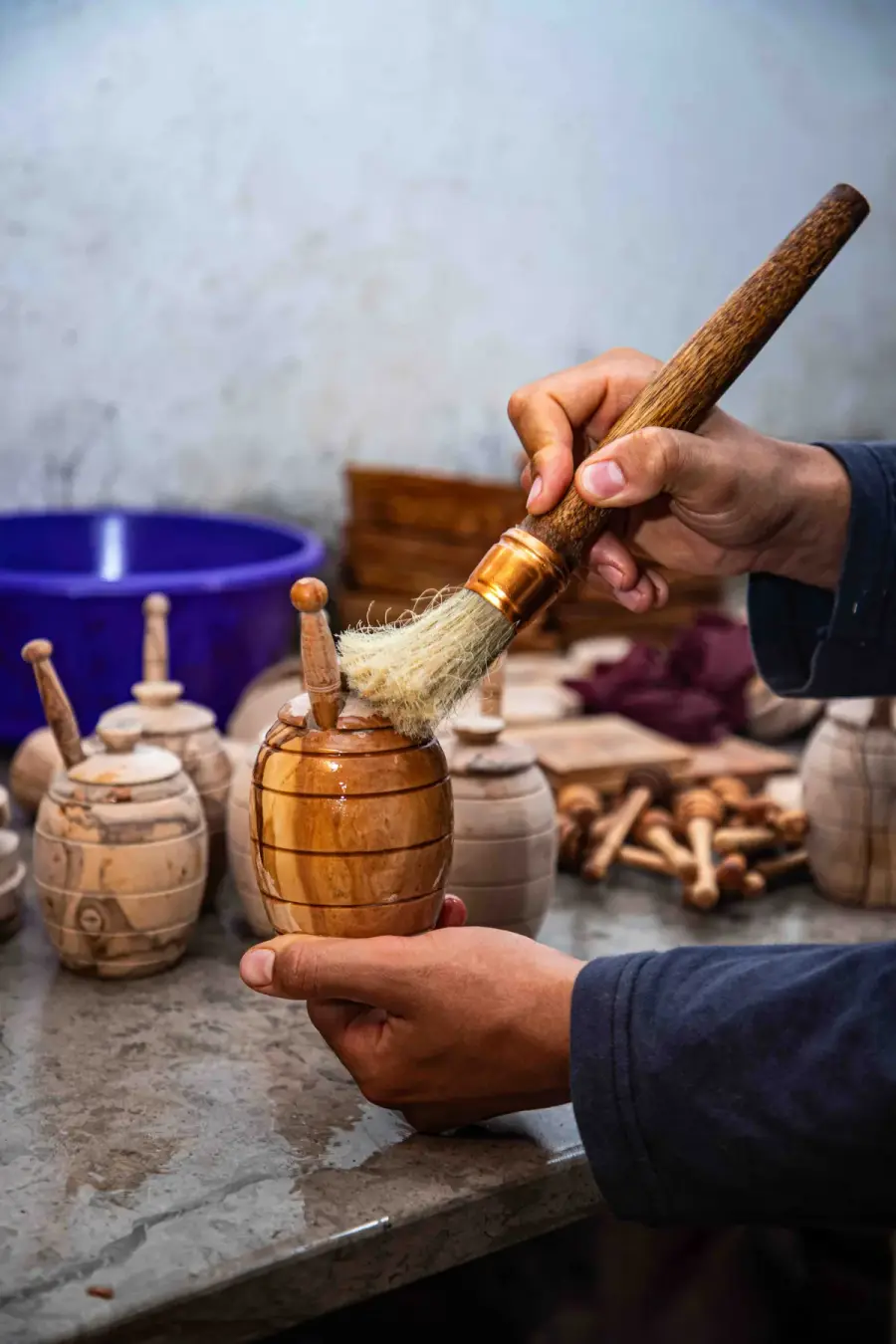
Thin coats, time to soak in, then the excess wiped off: the same routine in the workshop and in a kitchen.
How often. About once a month at home, or every 5 to 7 washes for pieces in daily use; weekly in busy professional kitchens; and at once whenever the wood looks pale. A simple test: a drop of water should bead on the surface. If it soaks in and darkens the wood, it is time to re-oil.
Cover every surface. Oil and wax the underside, edges, handles and the inside of cups and bowls, not only the face you see. Faces sealed differently take up moisture at different rates, which is the same uneven movement that warps a board.
One-step balms. A ready-mixed beeswax-and-oil balm, such as the one ArtisRaw supplies, can replace steps 2 to 5 for routine top-ups. Take a small dab on a cotton cloth, spread an even coat over every surface, leave it about 5 minutes, check nothing was missed, then buff off the excess. Use the two-step oil-then-wax routine for pieces that are dry, pale or freshly sanded, because they need more oil than a balm carries.
If customers want a petroleum-free product, a beeswax and carnauba balm, or fractionated coconut oil, avoids the rancidity problem. Test any new product on one piece first.
How to care for olive wood by product
The rules above apply to every piece, but each product has one weak point worth knowing. Find yours below.
Olive wood cutting and chopping boards
Large flat faces cup when one side stays wet, and knife cuts expose fresh fibres that take up water. Wash and oil both faces even if you cut on only one, dry the board on its edge, and re-oil weekly if it is in daily use. Olive wood cutting boards →
Olive wood serving boards, platters and trays
Fats, juices and warm food are the main stress. Wipe and wash soon after serving, let very hot food rest before it goes on the board, and re-oil about once a month. Olive wood trays and plates →
Olive wood spoons, spatulas and utensils
Heat and steam from the pan are the risk, not the stirring. Do not leave a spoon resting in a hot pot, wash it as soon as cooking ends, and dry it head-up in a utensil pot. Re-oil every 5 to 7 washes. Olive wood spoons and spatulas →
Olive wood bowls and salad bowls
Vinegar and lemon in dressings dry the finish faster than plain foods. Rinse the bowl soon after serving, never leave dressing standing in it, and oil the inside and the outside so both take up moisture evenly. Olive wood bowls and baskets →
Olive wood cups, mugs and tumblers
Liquid stays in contact with the inside for a long time, and the rim and base expose end grain. We recommend olive wood cups for cold and room-temperature drinks; hot liquids stress the wood the way a dishwasher does. Empty and rinse after use, towel the inside dry and leave it open to air before storing. Re-oil the inside weekly if it is used every day. Olive wood drinkware →
Olive wood mortars and pestles
Garlic, spices and oily pastes leave smells and colour in the grain. Brush it out with warm water, add a drop of washing-up liquid for oily pastes, and leave it open to dry. Use the baking-soda paste for lingering smells and re-oil when the inside looks pale. Olive wood mortars and pestles →
Olive wood jars, boxes and salt cellars
Lids and hinges trap moisture, and salt draws water from the air. Wipe rather than wash where you can, dry every part before closing the lid, and keep salt cellars away from cooking steam. Olive wood jars and containers →
Olive wood bath and beauty pieces
Soap dishes, combs, brushes and massage tools live in steady humidity. Let a soap dish drain and dry between uses, wipe combs and tools after each use, keep pieces out of direct shower spray, and re-oil about once a month. Olive wood bath and beauty →
Olive wood chess sets and décor
These pieces are rarely wet; dust and sunlight are the risks. Dust them with a soft dry cloth and keep them out of direct sun. Check the finish before oiling: some décor pieces and chess sets carry a varnish, which should never be oiled. Olive wood chess and board games →
Varnished and epoxy resin pieces: a different finish, different care
Oil and wax soak into the wood; varnish and epoxy resin sit on top of it. Those pieces are cleaned differently, and their varnish or resin must never be oiled.
How to tell which finish you have. Oil-and-wax finished olive wood feels like wood: satin and very slightly textured. A drop of mineral oil on a hidden spot darkens and soaks in. Varnish or lacquer feels smooth and glassy, and the oil sits on top. Resin pieces are easy to spot: clear or coloured resin set into or between the wood. If in doubt, check the product sheet or ask us.
Varnished or lacquered olive wood
- Dust with a soft, dry cloth; wipe marks with a barely damp cloth and dry at once.
- Never oil or wax a varnished surface: nothing soaks in, and it leaves a greasy film.
- Keep alcohol, solvents and silicone polishes away from it, and keep it out of heat and direct sun.
Olive wood with epoxy resin
Olive wood and epoxy react differently to water, heat and light, so care must protect whichever is weaker at each point.
- Keep conditions steady. Wood swells and shrinks with moisture; cured epoxy does not move the same way. Large swings in humidity strain the line where they join, so never soak these pieces and keep them away from heaters and air vents.
- No hot pans or mugs. Most tabletop epoxies begin to soften at 100 to 130 °F (38 to 54 °C), measured as heat deflection temperature (MAS Epoxies). Anything hot enough to burn you can mark the resin, so use trivets and coasters and never a dishwasher.
- Keep it out of direct sun. UV light is the most common cause of yellowing in cured epoxy, and no manufacturer can guarantee a resin will never yellow (ArtResin). Prevention is the only remedy.
- Clean gently. Use warm soapy water and a soft sponge, then dry at once. Abrasive pads and harsh cleaners scratch and dull the resin.
- Oil only the wood. Apply mineral oil or balm to the wooden areas, wipe off anything that reaches the resin, and never wax or polish the resin itself.
- Never cut on resin. Knife marks scratch it permanently.
How to restore dry or damaged olive wood
A pale, rough or knife-marked piece of solid olive wood can almost always be brought back with sandpaper and oil. Our workshop sands every piece from 80 to 400 grit, so finishing at 400 restores the surface it left the factory with.
When to refinish: the wood stays pale even after oiling, the surface feels fuzzy, knife marks catch the cloth, a stain will not lift, or a cooking-oil film has turned sticky.
When not to: veneered items, cracks that run through the piece, and loose joints. Retire those from kitchen use. On engraved or personalised pieces, sand only lightly around the engraving, or you will remove it.
- Protect yourself. Sand outdoors or with dust extraction and wear a dust mask. Olive wood dust is reported as a sensitiser that can irritate eyes and skin.
- Clean and dry for at least a day. Scrub a sticky film off with warm water, washing-up liquid and a brush first.
- Sand along the grain. Start at 240 grit for a pale or slightly rough piece. Start at 180 only for knife marks or deep stains, then move to 240. Wrap the paper round a sponge for curved spoons and bowls.
- Raise the grain. Wipe the surface with a barely damp cloth and let it dry for an hour. Loose fibres stand up now instead of after the first wash.
- Finish at 400 grit with light pressure, along the grain.
- Remove the dust dry, with a brush, vacuum or dry cloth. Water at this stage would lift the fibres again.
- Oil twice over two days. Apply mineral oil, leave it overnight, wipe off the excess, and repeat the next day.
- Wax and buff as in the monthly routine.
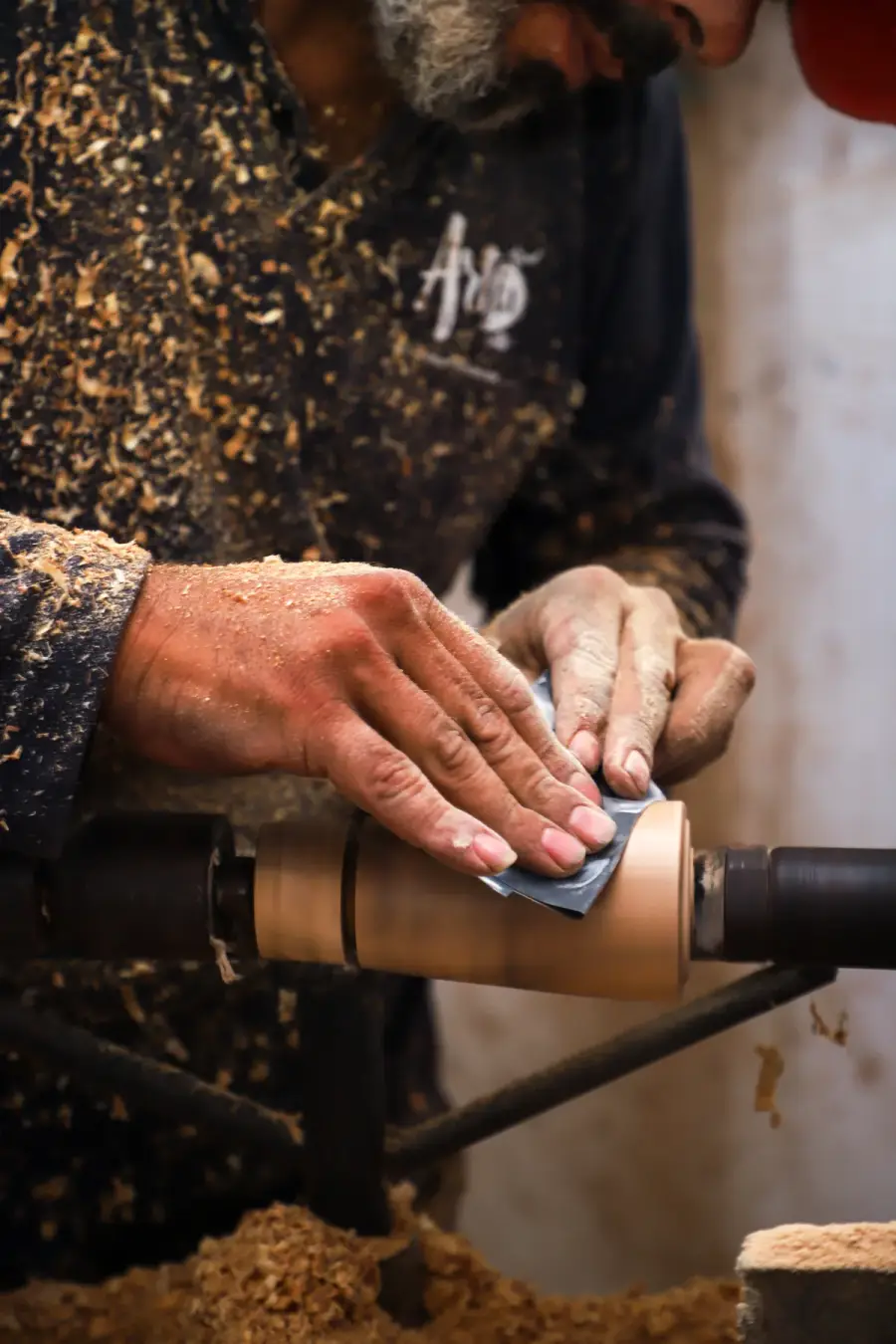
Sanding along the grain, finishing at 400 grit as in the workshop.
The figure usually comes back darker and richer than before, which makes refinished pieces worth showing to customers.
For retailers and distributors: receiving, storage and display
Retail stock needs the same two things as a kitchen board: steady conditions and enough oil. The risky moments are the first days after a sea shipment and the weeks under shop lighting.
On arrival
- Open cartons promptly and check them against the packing list. Report any piece damaged in transit with photos, as set out in our B2B terms.
- Remove any plastic wrapping so the wood can breathe.
- Let stock acclimatise unwrapped in the stockroom for a few days before display. We dry our wood to 10 ± 2% moisture; it will now gain or lose moisture until it matches your building, and a slow change is a safe change. This matters most when a shipment arrives in a heated store in winter.
In the stockroom
- Keep cartons off the floor and away from exterior doors, heaters, air vents and sunny windows.
- Never stack pieces that are damp, and never re-wrap them in plastic.
On display
- Keep olive wood away from hot spotlights, sunny windows and air-conditioning outlets.
- Dust with a dry cloth. Check display pieces once a month and re-oil any that look pale.
- Rotate stock so the same pieces are not under lights for months.
At the till
- Explain natural variation: every piece has its own grain and colour, and the colour deepens with age.
- Hand over the care card. Printed care cards in English or French ship free with every ArtisRaw wholesale order.
- Shelve a small care kit (mineral oil, beeswax balm, a cloth) next to your olive wood spoons and cutting boards.
Telling use damage from a defect. A grey, dry surface, grain raised all over, cracks running in from the ends and loose fittings together point to a dishwasher or soaking. A crack or loose fitting found on arrival is a supply issue: photograph it and report it to us.
Label the finish. Tell customers which pieces are varnished or combined with resin, because oiling those is a mistake. A line on the shelf card is enough.
Care and the warranty. Goods are warranted for 12 months from delivery, excluding normal wear and care-related damage, as set out in our B2B terms. Point customers to this guide when they ask what is covered.
Documents. A safety data sheet for our mineral oil and beeswax finish is available on request for your compliance file, alongside the documents listed on our quality and certifications page.
For chefs and hospitality buyers
In a professional kitchen the rules are the same as at home, but the pace is faster. Build olive wood care into the cleaning schedule rather than leaving it to memory.
- Never put olive wood through the warewasher. Commercial machines run hotter and longer than domestic ones, so the damage comes faster. Wash boards and utensils by hand at the sink straight after each task.
- No soaking in the pot sink, no stacking wet. Dry with a clean cloth and stand boards upright in a ventilated rack, away from ovens, the pass and warewasher steam.
- Harsh cleaning chemicals strip the finish faster than washing-up liquid does. A kitchen that uses them on wood daily should move to a weekly re-oil.
- Label boards on the underside rather than on the face. The underside is washed and oiled just as often, but it is not where the knife lands, so the label survives.
- Schedule the weekly re-oil for a quiet shift and log it on the cleaning schedule like any other task.
- Train the stewarding team. A laminated card at the pot sink with the four rules (hand wash, no soaking, upright drying, no warewasher) keeps the rules in front of everyone.
- Serving and presentation boards: let very hot food rest before plating on wood, and keep boards out from under heat lamps.
- Retire a board when a crack runs through it or a joint loosens.
Olive wood problems and how to fix them
Most problems with olive wood are surface problems, and a surface can be fixed. Find the symptom, check the likely cause, apply the fix.
| SYMPTOM | LIKELY CAUSE | FIX |
|---|---|---|
| Rough or fuzzy after the first few washes | Loose fibres lift the first time the wood gets wet (raised grain) | Sand lightly along the grain at 400 grit, then re-oil. It rarely comes back. |
| Pale, dull or grey | The oil has worn away | Re-oil and leave overnight. If it stays pale, refinish. |
| Sticky surface, stale smell | Cooking oil has oxidised in the grain | Scrub with warm water, washing-up liquid and a brush; dry for a day; sand 240 then 400; re-oil with mineral oil. |
| Lingering garlic, onion or fish smell | Odours held in the surface | Mix 2 tbsp baking soda, 1 tbsp salt and 3 tbsp hot water. Scrub, wipe with a warm damp towel, dry. A wipe of diluted white vinegar also freshens the surface. |
| Berry, beetroot, wine or turmeric stain | Pigment in the surface fibres | Dampen the wood, sprinkle coarse salt, scour with half a lemon, leave 5 minutes, brush off, rinse briefly and dry. Re-oil, because acid dries the wood. If it persists, sand it out. |
| Fine surface cracks, often at the ends | Fast or uneven drying | Oil generously, end grain first, and keep it away from heat. If a crack opens right through the piece, retire it from kitchen use. |
| Board has cupped | One face stayed wet while the other dried | Stand it upright to dry evenly for a few days; mild cupping often eases. Severe warping cannot be reliably reversed. |
| Dark spots that will not wash out | Water left standing, or damp storage | Sand out light marks and re-oil. If spots return after sanding, retire the piece from kitchen use. |
| Loose handle, lid, hinge or joint | Heat and water have weakened the glue or fitting | If found on arrival, photograph it and report it. In use, keep assembled items out of water. |
What the research says about wood and bacteria, and what it does not
No published study we know of has tested olive wood as a cutting surface, and ArtisRaw makes no antibacterial or hygiene claims for its products. Buyers ask about the research often, so here is what it actually shows.
The 1994 study everyone cites. Ak, Cliver and Kaspar at the University of Wisconsin put E. coli, Listeria and Salmonella on blocks cut from plastic boards and from nine hardwoods. Olive was not one of them. Clean wood usually absorbed the liquid within 3 to 10 minutes. At low doses the bacteria generally could not be recovered once inside the wood; at high doses, counts after 12 hours were down by at least 98%. On plastic, bacteria stayed recoverable and multiplied overnight. Mineral oil on the wood made little difference.
What that study does not show. “Could not be recovered” means the test methods could not lift them from the surface. It does not prove they were killed, and later work found bacteria at least 3 mm inside wood.
The 2023 study on oiled boards. Vega Gutierrez and colleagues tested beech, sugar maple and two oaks. A single coat of mineral or linseed oil kept significantly more bacteria on the surface for at least an hour; after 24 hours the difference was gone. Species mattered, but no single wood was best for both bacteria tested. The authors describe the popular idea that “less porous” woods are safer as a misunderstanding of wood anatomy.
What it means for a finished olive wood board. Results on raw wood do not transfer directly to oiled and waxed kitchenware like ours. The practical rule the research supports applies to every board, wood or plastic: wash it with soap and water soon after use, and let it dry.
Customer care card: text you can print
Retail partners can print this text on their own swing tags or inserts; it repeats the rules above in five lines and makes no claims beyond them.
OLIVE WOOD CARE
Handmade in Tunisia from olive wood. Every piece has its own grain and colour.
Wash by hand in warm water with mild soap. Never soak it. Never put it in a dishwasher, microwave or oven.
Towel dry at once, then stand it on its edge to finish drying.
Once a month, rub in pure mineral oil (cutting-board or USP grade), leave 20 minutes, wipe off, then add a thin beeswax balm. Never use cooking oils: they turn sticky and stale.
Keep it away from heat and direct sun.
Pale or rough? Sand lightly with 400-grit paper and re-oil.
Olive wood care: frequently asked questions
Can olive wood go in the dishwasher?
No. A dishwasher combines a long soak in hot water, alkaline detergent and a heated drying cycle. The wood swells and then dries too fast, which raises the grain, strips the oil, opens cracks and loosens joints. Wash olive wood by hand in warm, soapy water, towel it dry and stand it on its edge.
What is the best oil for olive wood?
Pure, unscented white mineral oil, sold for cutting boards or labelled USP or Ph. Eur., followed by a thin beeswax balm. Mineral oil cannot oxidise or turn rancid, and the wax slows water uptake at the surface. This is the same combination ArtisRaw uses to finish every piece in the workshop.
Can I use olive oil on olive wood?
We do not recommend it. Olive oil, like other cooking oils, contains unsaturated fats that slowly react with air inside the grain. Over weeks or months this can leave a sticky film and a stale smell. Olive oil changes more slowly than sunflower oil, but mineral oil does not change at all.
How often should olive wood be oiled?
About once a month for household use, weekly in busy professional kitchens, and whenever the wood looks pale. A simple test: a drop of water should bead on the surface. If it soaks in and darkens the wood, apply a thin coat of mineral oil, leave it 20 minutes to overnight, wipe off the excess and wax.
Why does a new olive wood board feel rough after the first wash?
The first wetting lifts loose surface fibres, which woodworkers call raised grain. It is normal and not a defect. Sand lightly along the grain with 400-grit paper, wipe off the dust with a dry cloth and re-oil. Once those fibres are removed, the surface usually stays smooth.
How do I remove stains and smells from olive wood?
For smells, scrub with a paste of 2 tablespoons baking soda, 1 tablespoon salt and 3 tablespoons hot water, then wipe and dry. For stains, scour with coarse salt and half a lemon, leave 5 minutes, brush off, rinse briefly and dry. Re-oil afterwards, because both treatments dry the wood.
How should retailers store and display olive wood?
Unpack stock promptly, remove any plastic and let it acclimatise for a few days before display. Keep it off the floor and away from heaters, air vents, exterior doors, hot spotlights and sunny windows. Check display pieces monthly and re-oil any that look pale.
Should I oil a new olive wood board before first use?
ArtisRaw pieces leave the workshop finished with mineral oil and beeswax, so they are ready to use. After a long journey, or if the surface feels dry, one fresh coat of mineral oil before first use does no harm. If the grain feels rough after the first wash, sand lightly at 400 grit and re-oil.
Why is my olive wood cracking?
Cracks come from wood drying too fast or unevenly: a dishwasher, soaking, drying flat or storage near heat. Olive wood’s tangential shrinkage (7.7%) is 1.6 times its radial shrinkage (4.9%), so uneven drying pulls it apart. Oil fine surface checks and keep the piece away from heat; retire any crack that runs right through.
How do you restore old or dry olive wood?
Clean it and let it dry for a day. Sand along the grain at 240 grit (180 for knife marks), raise the grain with a damp cloth, and finish at 400 grit. Remove the dust dry, oil twice over two days, then wax and buff. Veneered pieces and through-cracks cannot be restored this way.
Can olive wood cups be used for hot drinks?
We recommend olive wood cups and tumblers for cold and room-temperature drinks. Hot liquid standing inside the cup swells the wood quickly from one side, the same stress that makes dishwashers crack wood. Empty and rinse the cup after use, dry the inside, and re-oil it weekly if it is used every day.
How do you care for an olive wood mortar and pestle?
Brush it out with warm water after use, adding a drop of washing-up liquid for oily pastes, and leave it open to dry. For garlic or spice smells, scrub with a paste of baking soda, salt and hot water. Re-oil the inside when it looks pale, and never soak it.
Can I clean olive wood with vinegar or hydrogen peroxide?
Do not soak olive wood in any solution, whatever some guides suggest. A quick wipe with diluted white vinegar freshens the surface. Hydrogen peroxide can lighten wood, so test it on a hidden spot first. Either way, rinse briefly, dry at once and re-oil afterwards, because both dry the wood.
Does olive wood change colour over time?
Yes. Olive heartwood tends to deepen in colour with age, according to The Wood Database, and oiling darkens it further. Strong sunlight changes the colour unevenly, so keep pieces out of direct sun. A piece that turns grey or pale has lost its oil, and re-oiling usually brings the tone back.
How do you care for olive wood with epoxy resin?
Keep it away from heat, direct sun and standing water. Most tabletop epoxies start to soften at 38 to 54 °C, so use coasters and never a dishwasher, and UV light yellows resin. Wash with warm soapy water and a soft sponge, dry at once, oil only the wooden parts, and never cut on the resin.
Is olive wood antibacterial?
No published study we know of has tested olive wood as a cutting surface, and ArtisRaw makes no antibacterial claims for its products. Research on other hardwoods found that raw wood absorbs bacteria from its surface, but a 2023 study showed that an oil finish slows this. Wash any board, wood or plastic, with soap and water after use and let it dry.
Sources
Every published figure above comes from a page we opened on 4 October 2026; workshop figures are ArtisRaw’s own.
- The Wood Database. Olive (Olea europaea). wood-database.com/olive. Density, specific gravity, Janka hardness, shrinkage, pore structure, stability, colour change and the dust-sensitiser note.
- ArtisRaw workshop: drying to 10 ± 2% moisture, sanding from 80 to 400 grit, mineral oil and beeswax finish. See our olive wood factory in Sfax and inside the kiln.
- ArtisRaw Journal: olive wood properties and Chemlali olive wood.
- MAS Epoxies (2024). What is the heat rating of epoxy resin? Manufacturer guidance: heat deflection temperature (ASTM D648) of tabletop epoxies, typically 100–130 °F.
- ArtResin. Why does my resin look yellow? Manufacturer guidance: UV light as the main cause of yellowing in cured epoxy.
- ArtisRaw Care & Maintenance Manual, beeswax care sheet and resin care sheet (workshop documents): cleaning steps and the 5–7-wash re-oil rule.
- Ak, N. O., Cliver, D. O. & Kaspar, C. W. (1994). Cutting boards of plastic and wood contaminated experimentally with bacteria. Journal of Food Protection 57(1), 16–22. doi:10.4315/0362-028X-57.1.16
- Vega Gutierrez, S. M., Vega Gutierrez, P. T., Waite-Cusic, J. & Robinson, S. C. (2023). Wood cutting board finishes and their effect on bacterial growth. Coatings 13(4), 752. doi:10.3390/coatings13040752
About ArtisRaw. ArtisRaw (STE ART IS RAW) manufactures handmade Chemlali olive wood kitchenware, tableware and décor in Sfax, Tunisia, for retailers, distributors, hospitality groups and private-label brands. Its quality management system is certified ISO 9001:2015 by Bureau Veritas, certificate n° 45.2025.0143, valid November 2025 to November 2028. Route Saltnia Km 4.5, Sfax, Tunisia.
Care cards in English or French ship free with every wholesale order.
Request a wholesale quote